Volume of a Cylinder Formula (V = πr²h), Explained with Proof
The volume of a cylinder is V = πr²h. See what each part means, why the formula works, a worked example, units, common mistakes and practice.
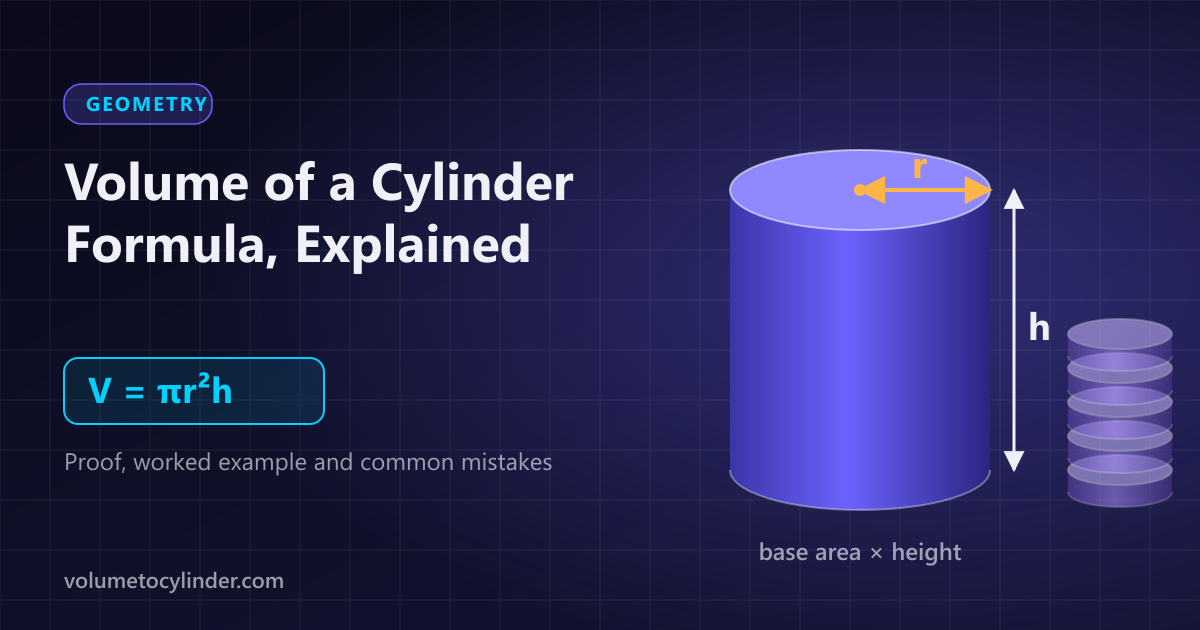
The volume of a cylinder is V = πr²h, where r is the radius of the circular base and h is the height. A cylinder is a three-dimensional solid with two parallel, identical circular bases joined by one curved surface. Volume tells you how much space a cylinder holds, so you need it to size water tanks, fill food cans, and work out how much liquid a pipe carries.
This guide covers the formula, what each symbol means, a proof based on Cavalieri’s principle, a full worked example, units, mistakes, and practice questions. You can check any answer with the cylinder volume calculator.
What Is the Formula for the Volume of a Cylinder?
The formula for the volume of a cylinder is V = πr²h.
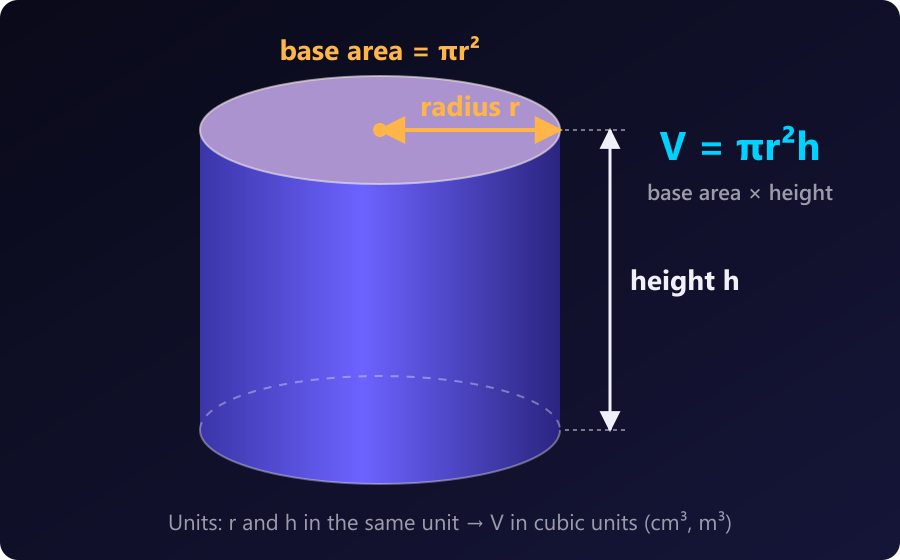
The formula has 3 parts:
- π (pi) is a constant equal to about 3.14159. Exam questions sometimes use 3.14 or 22/7.
- r (radius) is the distance from the centre of the circular base to its edge.
- h (height) is the perpendicular distance between the two circular bases.
Write the answer in cubic units, such as cubic centimetres (cm³) or cubic metres (m³).
What Does Each Part of V = πr²h Mean?
πr² is the area of the circular base, and h is the number of base-sized layers stacked on top of each other. The formula splits into two jobs:
- Base area (πr²). The area of any circle is π times the radius squared. A base with r = 7 cm has an area of π × 49 ≈ 153.94 cm².
- Height (h). Multiplying the base area by the height counts how many 1-unit-thick layers of that base fit inside the cylinder. A 10 cm tall cylinder holds 10 layers, each 1 cm thick.
So the volume of a cylinder is base area × height. The same rule gives the volume of every prism, including cubes and triangular prisms. A cylinder is a prism with a circular cross-section.
Why Does the Volume of a Cylinder Formula Work?
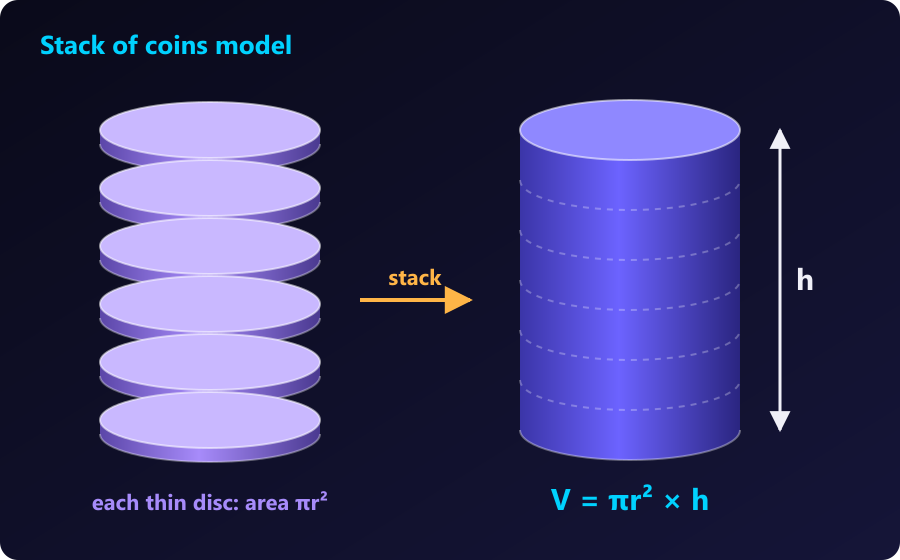
The volume of a cylinder formula works since a cylinder has the same cross-sectional area at every height. Two explanations show this: the stack of coins model and Cavalieri’s principle.
The Stack of Coins Model
A cylinder is a stack of identical thin discs. Each disc has an area of πr² and a tiny thickness. Stacking discs until the stack reaches height h gives a total volume of πr² × h. A stack of 20 coins, each 2 mm thick, is 40 mm tall, and its volume is the area of one coin face multiplied by 40 mm.
Cavalieri’s Principle in Simple Terms
Cavalieri’s principle states that two solids have equal volume when they have the same height and the same cross-sectional area at every level. The Italian mathematician Bonaventura Cavalieri published the idea in 1635.
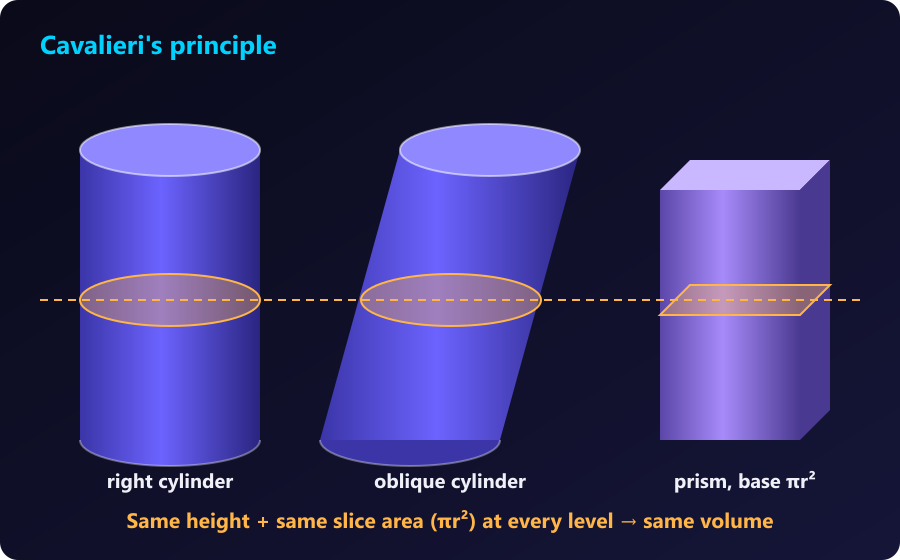
The proof of the cylinder volume formula takes 3 steps:
- Take a cylinder with radius r and height h. Every horizontal slice is a circle with area πr².
- Take a rectangular prism with the same height h and a base area equal to πr². Every horizontal slice of the prism has area πr².
- Both solids have equal slice areas at every level and equal heights, so both have equal volumes. The prism’s volume is base area × height = πr²h. So the cylinder’s volume is πr²h.
Cavalieri’s principle explains why an oblique cylinder (a slanted cylinder) has the same volume as a right cylinder with the same radius and perpendicular height. Pushing a stack of coins sideways changes its shape, not its volume.
Worked Example: Volume of a Cylinder with r = 7 cm and h = 10 cm
A cylinder with a radius of 7 cm and a height of 10 cm has a volume of about 1,539.4 cm³.
Follow 4 steps:
- Write the formula: V = πr²h.
- Square the radius: r² = 7² = 49 cm².
- Multiply by π: π × 49 ≈ 153.94 cm². This is the base area.
- Multiply by the height: 153.94 × 10 ≈ 1,539.38 cm³.
The volume is 1,539.4 cm³ to 1 decimal place. 1,000 cm³ equals 1 litre (L), so the cylinder holds about 1.54 L. With π = 22/7, the answer is exactly 1,540 cm³, since 22/7 × 49 × 10 = 1,540.
What Are the Units of Volume for a Cylinder?
The volume of a cylinder is measured in cubic units. The International System of Units (SI) unit of volume is the cubic metre (m³).
| Unit | Symbol | Equal to | Typical use |
|---|---|---|---|
| Cubic millimetre | mm³ | 0.001 cm³ | Small machine parts, pills |
| Cubic centimetre | cm³ | 1 millilitre (ml) | Cans, cups, school problems |
| Litre | L | 1,000 cm³ | Bottles, drums, fuel |
| Cubic metre | m³ | 1,000 L | Tanks, silos, concrete |
| Cubic inch | in³ | 16.387 cm³ | US engineering, pipes |
| Cubic foot | ft³ | 28.317 L | US construction, storage |
Use the same unit for radius and height. A radius in cm and a height in cm give a volume in cm³. A radius in m and a height in m give a volume in m³. The cylinder volume conversions guide covers litres, gallons, and cubic yards in full.
What Are the Common Mistakes in Cylinder Volume Problems?
There are 3 common mistakes in cylinder volume problems:
- Confusing πr²h with 2πrh. 2πrh is the curved surface area (CSA), the area of the label that wraps around the side. It is measured in square units, not cubic units. The volume vs surface area guide compares both.
- Using the diameter instead of the radius. The radius is half the diameter. Putting the diameter into πr²h makes the answer 4 times too big. A cylinder with d = 14 cm and h = 10 cm has V ≈ 1,539.4 cm³, not 6,157.5 cm³. The diameter method avoids this error.
- Mixing units. A radius of 50 cm and a height of 2 m must share one unit before you multiply. Convert to r = 0.5 m and h = 2 m to get V ≈ 1.571 m³, or to r = 50 cm and h = 200 cm to get V ≈ 1,570,796 cm³.
Quick Practice: Volume of a Cylinder Questions
Try these 3 questions, then check the answers.
- Find the volume of a cylinder with r = 3 cm and h = 5 cm.
- A cylinder has a radius of 0.5 m and a height of 2 m. Find its volume in m³.
- A tin has a diameter of 8 in and a height of 12 in. Find its volume in cubic inches (in³).
Answers
- V = π × 3² × 5 = π × 45 ≈ 141.37 cm³.
- V = π × 0.5² × 2 = π × 0.5 ≈ 1.571 m³ (about 1,571 L).
- r = 8 ÷ 2 = 4 in. V = π × 4² × 12 = π × 192 ≈ 603.19 in³.
The practice questions post has 28 more questions with full solutions.
Frequently Asked Questions
Is the volume of a cylinder 2πrh?
No, the volume of a cylinder is not 2πrh. 2πrh is the curved surface area of a cylinder. The volume of a cylinder is πr²h. The two formulas differ by one r and a factor of 2, and they measure different things: 2πrh gives square units (cm²) and πr²h gives cubic units (cm³).
What is the volume of a right circular cylinder?
The volume of a right circular cylinder is V = πr²h. A right circular cylinder has circular bases and a side that meets the bases at 90°. Cans, pipes, and most storage tanks are right circular cylinders.
Does an oblique cylinder use the same volume formula?
Yes, an oblique cylinder uses the same formula, V = πr²h, with h as the perpendicular height between the bases, not the slanted side length. Cavalieri’s principle proves the two volumes are equal.
What value of π should I use?
Use the π button on a calculator for the most accurate answer. Use 3.14 or 22/7, if the question tells you to. 22/7 gives neat answers when the radius is a multiple of 7.