Volume vs Surface Area of a Cylinder (CSA, TSA and Volume)
Volume (πr²h) measures space inside a cylinder; CSA (2πrh) and TSA (2πr(r + h)) measure the outside. Compare all three with examples.
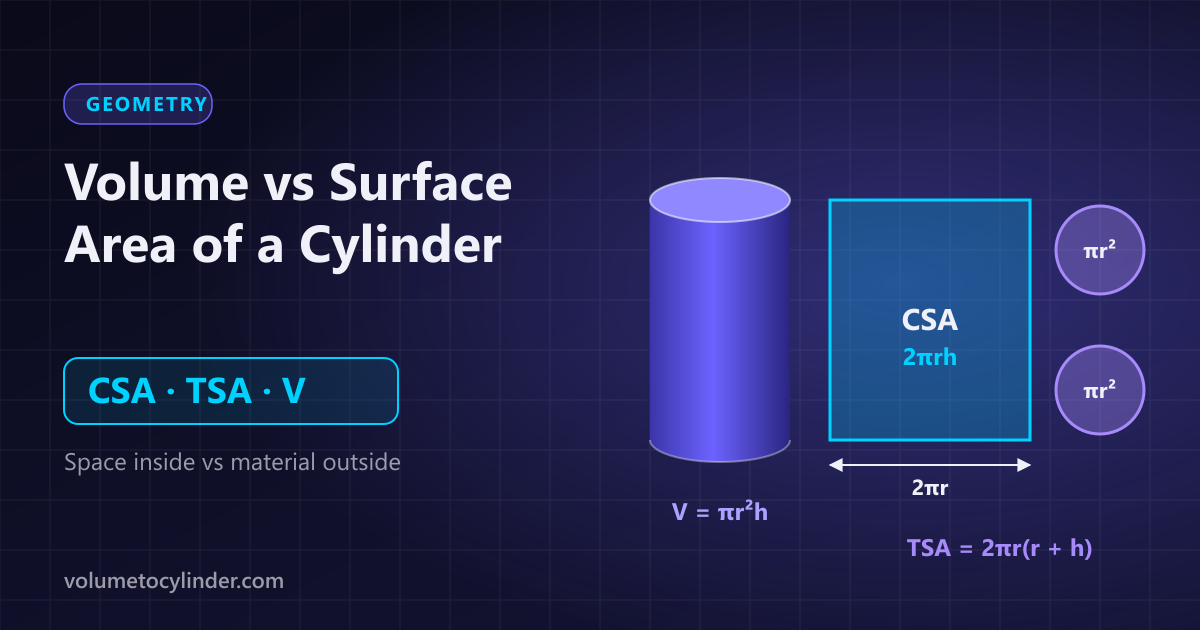
Volume measures the space inside a cylinder, and surface area measures the material that covers its outside. Volume answers “how much does it hold?” and uses cubic units (cm³). Surface area answers “how much paint, metal, or label covers it?” and uses square units (cm²).
A cylinder has 3 standard measurements:
- Volume: V = πr²h.
- Curved surface area (CSA): 2πrh.
- Total surface area (TSA): 2πr(r + h).
Students mix up these formulas more than any other cylinder topic. This guide puts all 3 side by side and works one cylinder through each. The surface area calculator links the two.
What Are the Volume, CSA and TSA Formulas of a Cylinder?
The 3 cylinder formulas are volume = πr²h, curved surface area = 2πrh, and total surface area = 2πr(r + h).
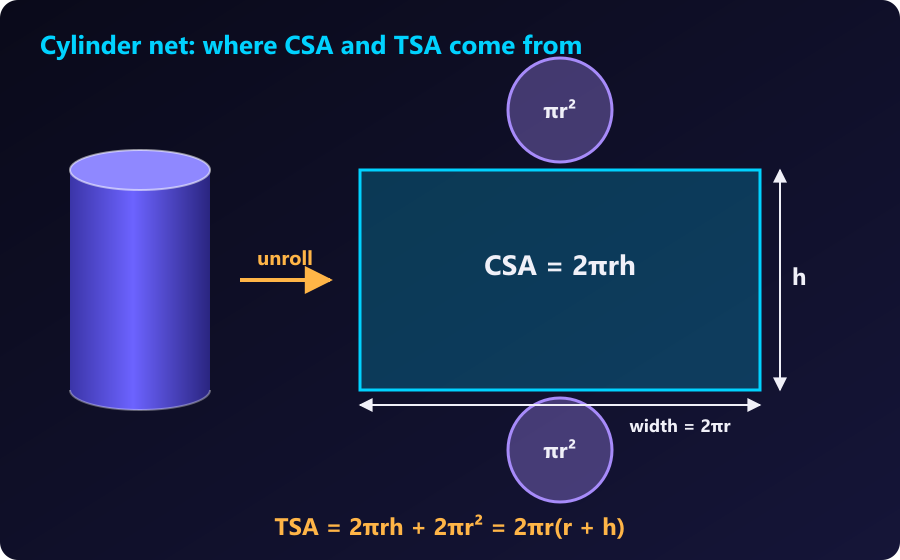
- Volume (πr²h) is the base area πr² times the height h.
- CSA (2πrh) is the side only. Unroll the side and it becomes a rectangle with width equal to the circumference (2πr) and height h. Some textbooks call CSA the lateral surface area (LSA).
- TSA (2πr(r + h)) is the side plus the 2 circular ends: 2πrh + 2πr². Factor out 2πr to get 2πr(r + h).
Volume vs CSA vs TSA Comparison Table
| Measurement | Formula | What it measures | Units | Real-life use |
|---|---|---|---|---|
| Volume | πr²h | Space inside the cylinder | cm³, m³, L | Filling a tank or a glass |
| Curved surface area (CSA) | 2πrh | Side wall only | cm², m² | Painting a pillar, a can label |
| Total surface area (TSA) | 2πr(r + h) | Side wall + top + bottom | cm², m² | Making a closed can or drum |
| Open cylinder area | πr² + 2πrh | Side wall + bottom only | cm², m² | A bucket, a cup, an open tank |
Real-Life Examples: Which Cylinder Formula Do You Use?
There are 3 everyday tasks, and each one uses a different formula.
Painting a Pillar Uses CSA
A round pillar has a radius of 0.3 m and a height of 4 m. The top and bottom touch the ceiling and floor, so only the side gets paint.
- CSA = 2 × π × 0.3 × 4 ≈ 7.54 m² (81.2 ft²).
- Paint covers about 10 m² per litre per coat. Two coats need 7.54 × 2 ÷ 10 ≈ 1.5 L of paint.
Making a Closed Can Uses TSA
A food can has a radius of 4 cm and a height of 11 cm. The maker needs metal for the side, the lid, and the base.
- TSA = 2 × π × 4 × (4 + 11) = 120π ≈ 377.0 cm² of sheet metal.
Filling a Tank Uses Volume
A water tank has a radius of 0.5 m and a height of 1.2 m.
- V = π × 0.5² × 1.2 ≈ 0.9425 m³ = 942.5 L (249 US gallons).
One Cylinder, Three Answers: Worked Example with r = 7 cm and h = 10 cm
A cylinder with r = 7 cm and h = 10 cm has a volume of 1,539.38 cm³, a CSA of 439.82 cm², and a TSA of 747.70 cm².
Volume
- Base area: π × 7² = 49π ≈ 153.94 cm².
- Volume: 153.94 × 10 ≈ 1,539.38 cm³.
Curved surface area
- Circumference: 2 × π × 7 = 14π ≈ 43.98 cm.
- CSA: 43.98 × 10 ≈ 439.82 cm².
Total surface area
- Two ends: 2 × 153.94 ≈ 307.88 cm².
- TSA: 439.82 + 307.88 ≈ 747.70 cm².
- Check with the factored formula: 2 × π × 7 × (7 + 10) = 238π ≈ 747.70 cm².
With π = 22/7, the answers come out as whole numbers: V = 1,540 cm³, CSA = 440 cm², TSA = 748 cm².
What Is the Surface Area of an Open Cylinder with No Top?
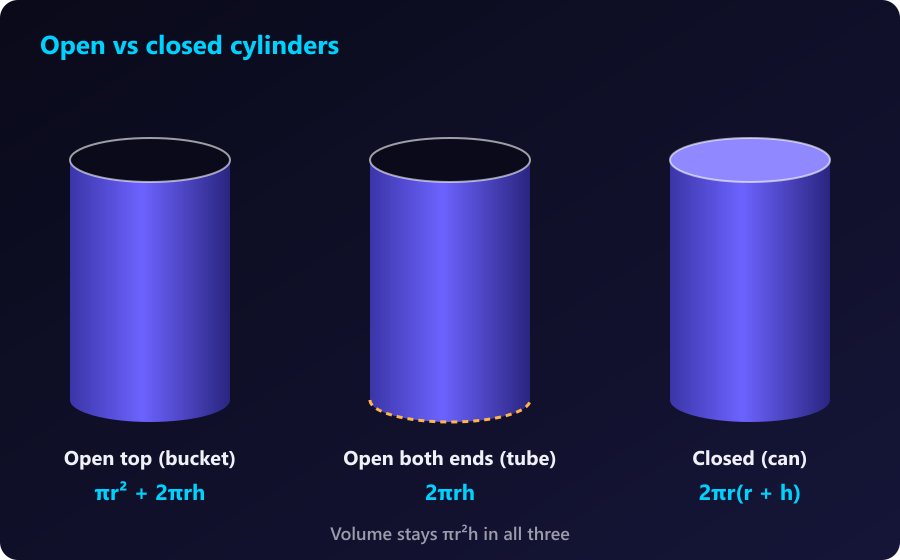
The surface area of an open cylinder with no top is πr² + 2πrh, the curved side plus one base. Exam questions about buckets, cups, glasses, tanks without lids, and swimming pools test this case.
For the r = 7 cm, h = 10 cm cylinder:
- Open cylinder area = 153.94 + 439.82 ≈ 593.76 cm².
There are 3 versions of this exam trap:
- Open at one end (bucket, cup): πr² + 2πrh.
- Open at both ends (pipe, tube): 2πrh only, the same as CSA.
- Closed at both ends (can, drum): 2πr(r + h), the TSA.
Read the question for words such as “open,” “without a lid,” or “no top” before choosing the formula. The volume does not change for an open cylinder: the cup still holds πr²h. The without top and bottom calculator handles the tube case.
What Is the Volume-to-Surface-Area Ratio of a Cylinder?
The volume-to-surface-area ratio of a cylinder is V ÷ TSA = rh ÷ 2(r + h). The ratio tells you how much space you get per unit of material.
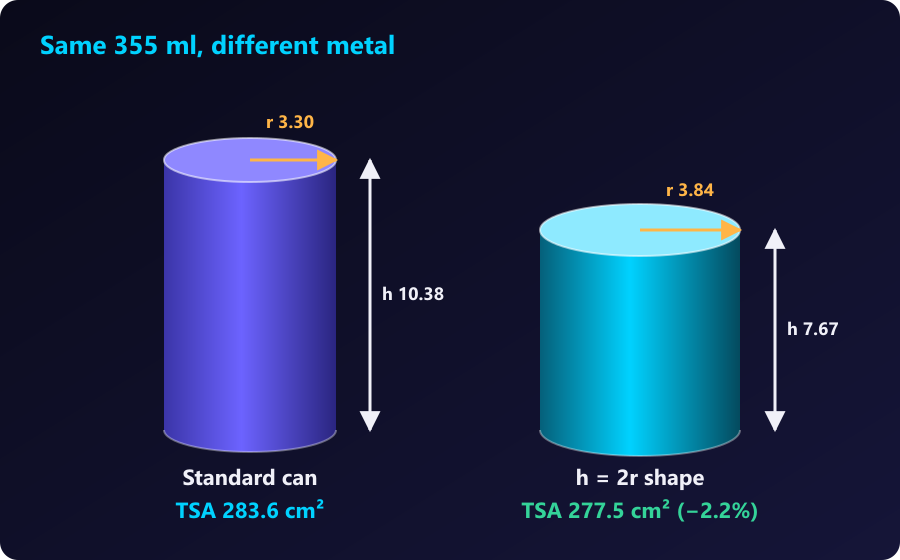
For a fixed volume, a closed cylinder uses the least material when its height equals its diameter (h = 2r).
Example: a 355 ml drink can.
| Can shape | Radius | Height | Volume | Total surface area |
|---|---|---|---|---|
| Standard 12 oz can (approx.) | 3.30 cm | 10.38 cm | 355 cm³ | 283.6 cm² |
| Material-saving shape (h = 2r) | 3.84 cm | 7.67 cm | 355 cm³ | 277.5 cm² |
The material-saving can uses only 2.2% less metal. Drinks companies choose the taller shape for 4 reasons:
- Grip. A narrower can fits a hand.
- Stacking and vending. Machines and fridge shelves are built for the standard size.
- Thick ends. The lid and base use thicker aluminium than the wall, so a design with smaller ends saves more metal than the TSA formula shows.
- Display. A taller can shows more label on a shelf.
Food cans, paint tins, and fuel drums sit closer to h = 2r, since stacking height matters less for those products.
Memory Tricks for Cylinder Formulas
There are 4 ways to stop mixing up cylinder formulas:
- Count the r’s. Volume is cubic, so it has 3 length symbols: r × r × h. CSA is square, so it has 2: r × h.
- Picture the label. Peel the label off a can and lay it flat. The label is a rectangle: circumference (2πr) × height (h) = 2πrh.
- Look for the 2. Surface area formulas start with 2π. The volume formula starts with plain π.
- Add the lids. TSA = label + 2 lids = 2πrh + 2πr².
Frequently Asked Questions
What is the difference between CSA and TSA of a cylinder?
CSA (2πrh) covers only the curved side of the cylinder. TSA (2πr(r + h)) covers the curved side plus the top and bottom circles.
Is lateral surface area the same as curved surface area?
Yes, lateral surface area and curved surface area are the same for a cylinder. Both equal 2πrh.
Can a cylinder’s volume and surface area be the same number?
Yes, the numbers can match, but the units never do. A cylinder with r = 4 and h = 4 has V = 64π and TSA = 64π, but one is in cubic units and the other in square units.
Which is bigger, volume or surface area?
Neither is bigger in general, since they use different units. Small cylinders have more surface area per unit of volume than large cylinders.