How to Find the Volume of a Cylinder Using Diameter
Find the volume of a cylinder from its diameter with V = πd²h/4. Step-by-step method, pipe example, a diameter table and the mistake to avoid.
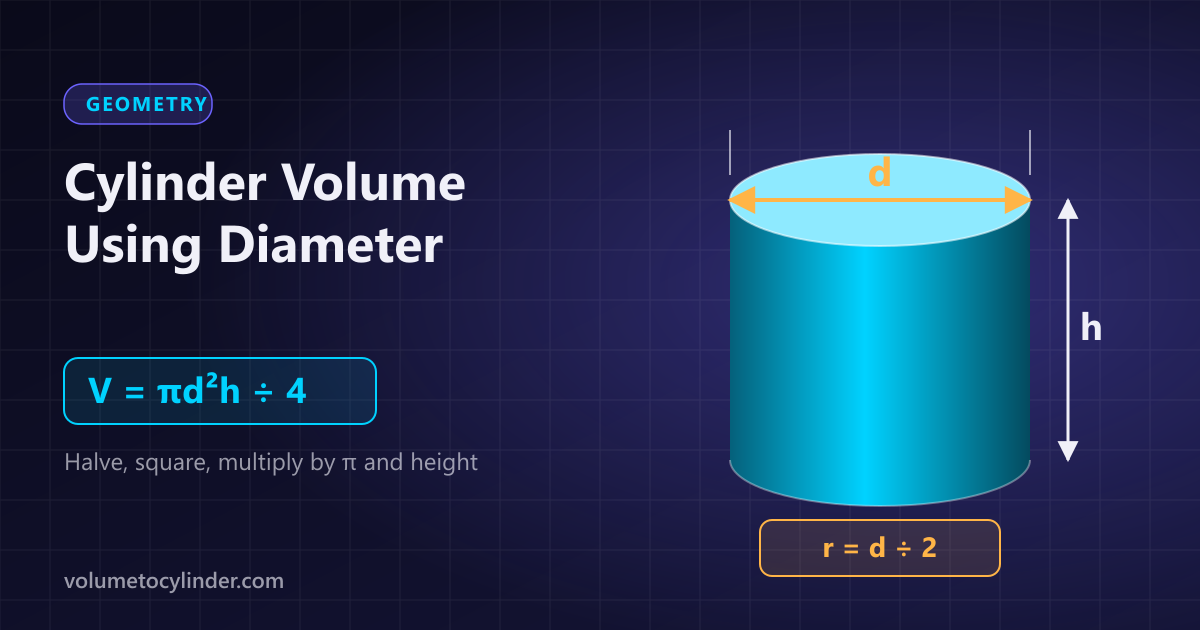
To find the volume of a cylinder using diameter, use V = πd²h ÷ 4, where d is the diameter and h is the height. The formula gives the same answer as V = πr²h, with the halving of the diameter built in.
Most real objects give you the diameter, not the radius. A tape measure or caliper reads straight across a can. Pipes are sold by diameter, such as a 4-inch pipe or a 110 mm pipe. Finding the exact centre of a circle to measure the radius is hard, but measuring edge to edge is easy.
The using-diameter calculator runs this formula for you.
What Is the Formula for the Volume of a Cylinder Using Diameter?
The formula for the volume of a cylinder using diameter is V = π(d/2)²h, which simplifies to V = πd²h/4.
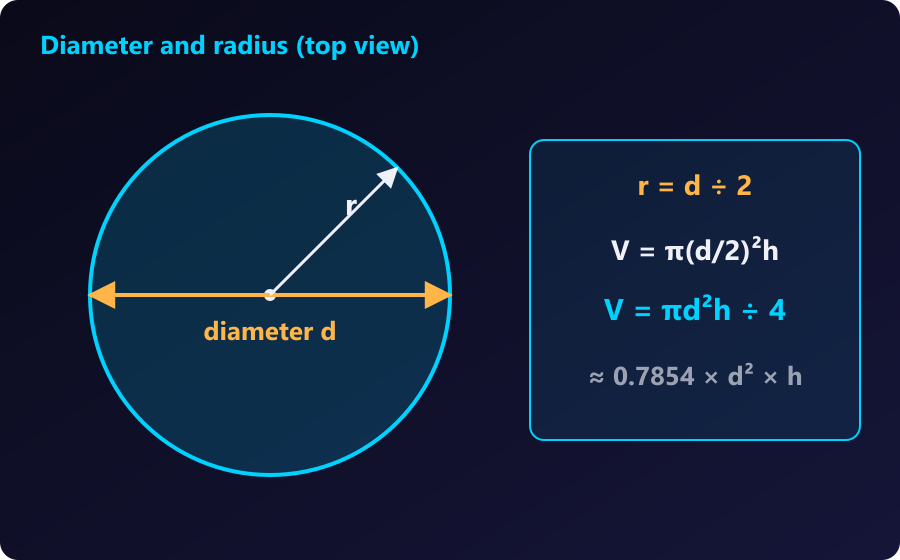
The radius is half the diameter (r = d/2). Substituting r = d/2 into V = πr²h gives:
- V = π × (d/2)² × h
- V = π × (d²/4) × h
- V = πd²h/4
π ÷ 4 ≈ 0.7854, so a quick version of the formula is V ≈ 0.7854 × d² × h. Engineers use 0.7854 for pipe and bore calculations.
How Do You Find the Volume of a Cylinder from Its Diameter?
To find the volume of a cylinder from its diameter, follow 4 steps:
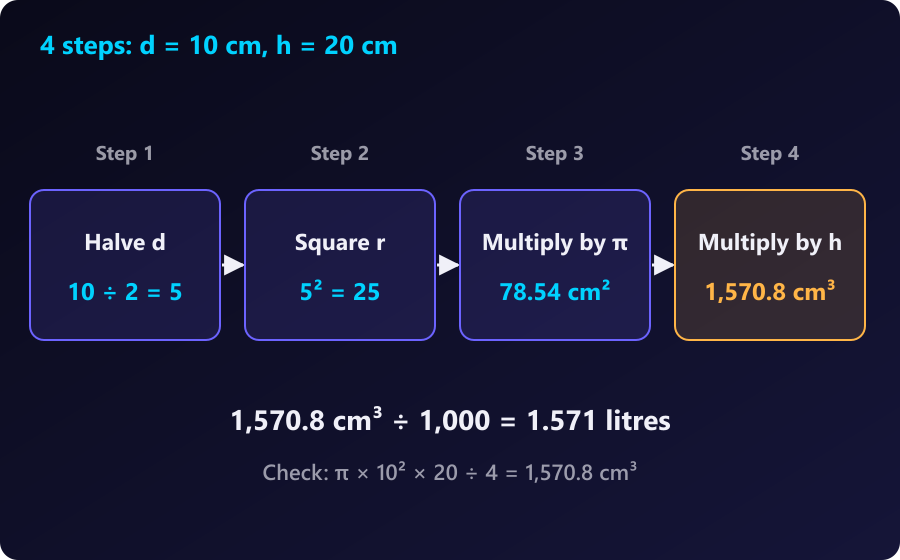
- Halve the diameter to get the radius: r = d ÷ 2.
- Square the radius: r × r.
- Multiply by π to get the base area.
- Multiply by the height to get the volume.
Keep the diameter and height in the same unit before you start.
Worked Example 1: Diameter 10 cm, Height 20 cm
A cylinder with a diameter of 10 cm and a height of 20 cm has a volume of about 1,570.8 cm³ (1.57 L).
- Halve the diameter: r = 10 ÷ 2 = 5 cm.
- Square the radius: 5² = 25 cm².
- Multiply by π: π × 25 ≈ 78.54 cm².
- Multiply by the height: 78.54 × 20 ≈ 1,570.8 cm³.
Check with the direct formula: V = π × 10² × 20 ÷ 4 = π × 2,000 ÷ 4 = π × 500 ≈ 1,570.8 cm³. Both methods match. 1,570.8 cm³ ÷ 1,000 = 1.571 litres (L).
Worked Example 2: Water in a 4-Inch Pipe That Is 3 Feet Long
A 4-inch pipe that is 3 feet long holds about 452.4 cubic inches (in³), which equals 1.96 US gallons (gal) or 7.41 litres.
This example mixes inches (in) and feet (ft), so convert first.
- Match the units. Length = 3 ft × 12 = 36 in. Diameter = 4 in.
- Halve the diameter. r = 4 ÷ 2 = 2 in.
- Square the radius. 2² = 4 in².
- Multiply by π. π × 4 ≈ 12.566 in².
- Multiply by the length. 12.566 × 36 ≈ 452.39 in³.
- Convert to gallons. 1 US gallon = 231 in³, so 452.39 ÷ 231 ≈ 1.958 gal.
- Convert to litres. 1 in³ = 0.016387 L, so 452.39 × 0.016387 ≈ 7.41 L.
Use the inside diameter (ID) to find how much water a pipe holds. A “4-inch” pipe is a nominal pipe size (NPS), and the real inside diameter of a 4-inch Schedule 40 steel pipe is about 4.026 in. Measure the bore, if the answer must be exact. Use the outside diameter (OD) and ID together, if you need the volume of pipe material. The hollow cylinder guide covers that case.
What Is the Biggest Mistake When Using Diameter?
The biggest mistake is forgetting to halve the diameter. Putting the diameter into πr²h makes the answer 4 times too big, since squaring doubles the error: (2r)² = 4r².
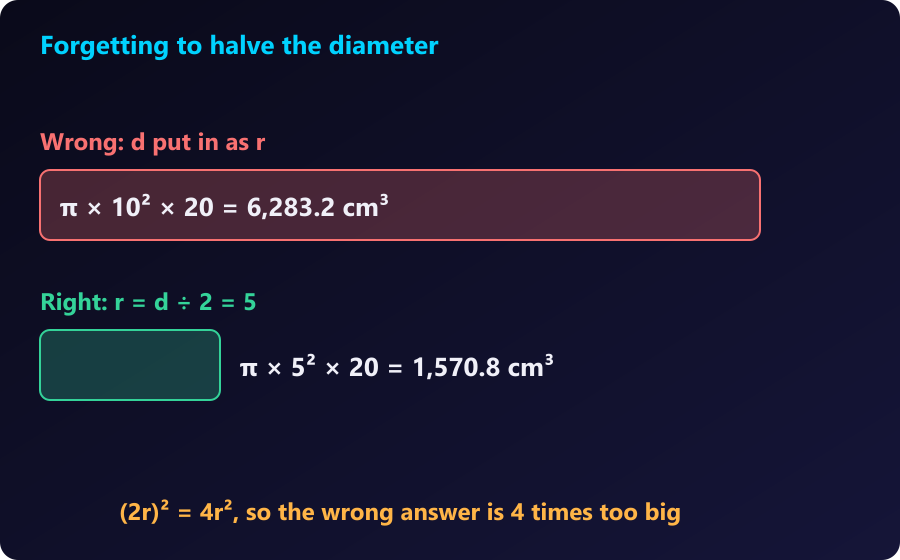
Example: d = 10 cm, h = 20 cm.
- Wrong: π × 10² × 20 ≈ 6,283.2 cm³.
- Right: π × 5² × 20 ≈ 1,570.8 cm³.
6,283.2 ÷ 1,570.8 = 4. An answer exactly 4 times the expected size points to this mistake.
There are 2 more mistakes to watch for:
- Mixed units. A diameter in inches and a length in feet give a meaningless number. Convert both to inches or both to feet.
- Wrong diameter. Measure across the widest part of the circle, through the centre. A tape placed off-centre reads short.
Mini Calculator Table: Volume per Unit of Height by Diameter
This table gives the volume of a cylinder for 1 unit of height. Multiply the value by your height to get the total volume.
Metric diameters (volume per 1 cm of height and per 1 m of length)
| Diameter (cm) | Base area (cm²) = volume per 1 cm height (cm³) | Litres per 1 m length |
|---|---|---|
| 1 | 0.79 | 0.079 |
| 2 | 3.14 | 0.314 |
| 3 | 7.07 | 0.707 |
| 4 | 12.57 | 1.257 |
| 5 | 19.63 | 1.963 |
| 6 | 28.27 | 2.827 |
| 8 | 50.27 | 5.027 |
| 10 | 78.54 | 7.854 |
| 12 | 113.10 | 11.310 |
| 15 | 176.71 | 17.671 |
| 20 | 314.16 | 31.416 |
| 25 | 490.87 | 49.087 |
| 30 | 706.86 | 70.686 |
| 50 | 1,963.50 | 196.350 |
| 100 | 7,853.98 | 785.398 |
Imperial diameters (volume per 1 inch of height and per 1 foot of length)
| Diameter (in) | Volume per 1 in height (in³) | US gallons per 1 ft length |
|---|---|---|
| 0.5 | 0.196 | 0.0102 |
| 0.75 | 0.442 | 0.0229 |
| 1 | 0.785 | 0.0408 |
| 1.5 | 1.767 | 0.0918 |
| 2 | 3.142 | 0.1632 |
| 3 | 7.069 | 0.3672 |
| 4 | 12.566 | 0.6528 |
| 6 | 28.274 | 1.4688 |
| 8 | 50.265 | 2.6112 |
| 10 | 78.540 | 4.0800 |
| 12 | 113.097 | 5.8752 |
Example: a 6-inch pipe that is 20 ft long holds 1.4688 × 20 ≈ 29.4 US gallons.
Frequently Asked Questions
Can I use the diameter instead of the radius in the cylinder volume formula?
Yes, you can use the diameter, with the formula V = πd²h/4. Do not put the diameter into V = πr²h, since the answer comes out 4 times too big.
How do I find the radius from the diameter?
Divide the diameter by 2. A cylinder with a diameter of 18 cm has a radius of 9 cm.
What is 0.7854 in pipe volume formulas?
0.7854 is π ÷ 4 rounded to 4 decimal places. Volume = 0.7854 × d² × length gives the same result as πd²h/4.
Which diameter do I use for a pipe?
Use the inside diameter (ID) to find how much liquid a pipe holds. Use the outside diameter (OD) and the inside diameter together to find the volume of the pipe wall.
How do I find the diameter if I only know the circumference?
Divide the circumference by π: d = C ÷ π. The circumference guide shows the full volume method.