Volume of a Cylinder Using Circumference
Find cylinder volume from circumference with V = C²h ÷ 4π. Includes the derivation, a pillar and a tree trunk example, measuring tips and practice.
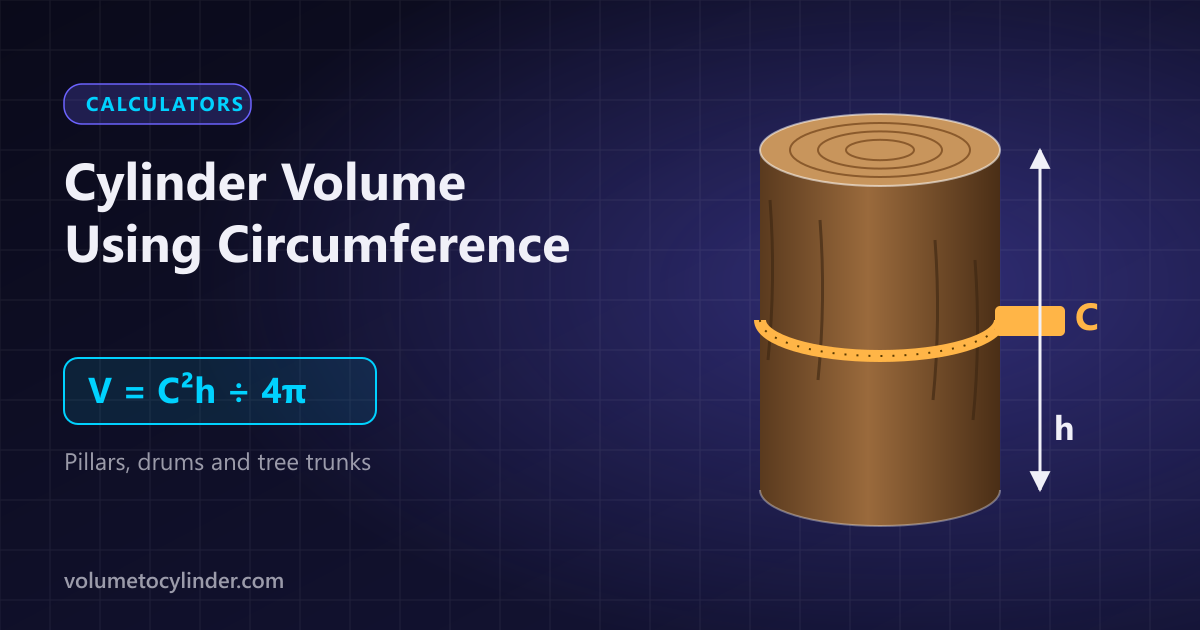
The volume of a cylinder from its circumference is V = C²h ÷ 4π, where C is the circumference and h is the height. Use this formula when you can wrap a tape around an object but cannot reach its centre to measure the radius.
There are 4 common objects where circumference is the easy measurement:
- Tree trunks and logs, where foresters measure girth.
- Pillars and columns fixed in a building.
- Drums and barrels with lids or rims in the way.
- Large pipes and silos too wide for a caliper.
The circumference calculator runs this formula.
How Do You Find the Radius from the Circumference?
To find the radius from the circumference, divide the circumference by 2π: r = C ÷ 2π. The circumference formula is C = 2πr, so dividing both sides by 2π gives r.
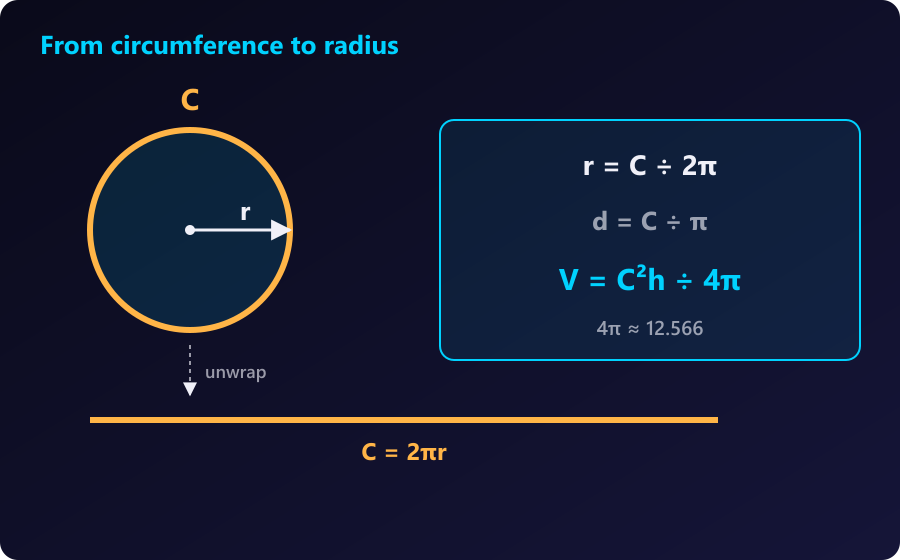
Example: a pillar with a circumference of 2 m has a radius of 2 ÷ (2π) = 2 ÷ 6.2832 ≈ 0.318 m (31.8 cm).
The diameter is d = C ÷ π. A 2 m circumference gives a diameter of 2 ÷ 3.1416 ≈ 0.637 m.
What Is the Direct Formula for Volume Using Circumference?
The direct formula is V = C²h ÷ 4π. It skips the radius step, which cuts rounding errors.
The derivation takes 4 steps:
- Start with V = πr²h.
- Substitute r = C ÷ 2π: V = π × (C ÷ 2π)² × h.
- Square the bracket: V = π × C² ÷ (4π²) × h.
- Cancel one π: V = C²h ÷ 4π.
4π ≈ 12.566, so a quick version is V ≈ C² × h ÷ 12.566, or V ≈ 0.0796 × C² × h.
Worked Example 1: A Pillar with C = 2 m and h = 3 m
A pillar with a circumference of 2 m and a height of 3 m has a volume of about 0.955 m³ (955 L).
Direct formula
- Square the circumference: C² = 2² = 4 m².
- Multiply by the height: 4 × 3 = 12 m³.
- Divide by 4π: 12 ÷ 12.566 ≈ 0.9549 m³.
Check through the radius
- r = 2 ÷ 2π ≈ 0.3183 m.
- V = π × 0.3183² × 3 ≈ 0.9549 m³.
Both routes match. A concrete pillar of this size weighs about 0.955 × 2,400 ≈ 2,292 kg (2.3 tonnes).
Worked Example 2: Estimating the Timber Volume of a Tree Trunk
A felled log 5 m long has girths of 2.0 m at the base, 1.8 m in the middle, and 1.6 m at the top. Its estimated timber volume is about 1.29 m³ (45.5 ft³).
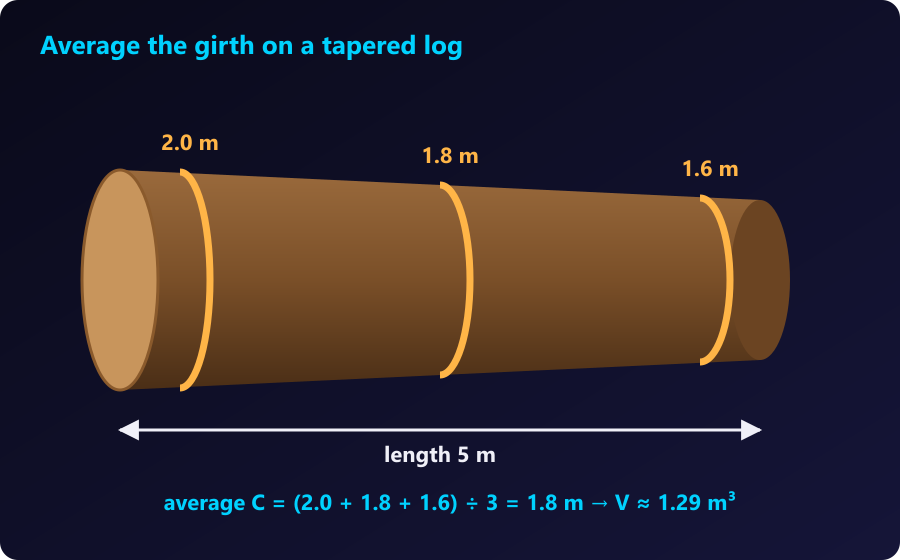
A tree trunk tapers, so it is not a perfect cylinder. Average the girths to treat the log as a cylinder with one circumference.
- Average the circumference readings. (2.0 + 1.8 + 1.6) ÷ 3 = 1.8 m.
- Square the average. 1.8² = 3.24 m².
- Multiply by the length. 3.24 × 5 = 16.2.
- Divide by 4π. 16.2 ÷ 12.566 ≈ 1.289 m³.
- Convert to cubic feet, if needed. 1.289 × 35.315 ≈ 45.5 ft³.
Foresters use 2 standard methods for log volume:
- Mid-girth method (Huber’s formula). Measure the girth at the middle of the log and treat the log as a cylinder. This log’s mid-girth is 1.8 m, so the result matches the average: 1.29 m³.
- Hoppus method. British and Commonwealth timber trade uses the Hoppus foot, which takes (girth ÷ 4)² × length. For this log: (1.8 ÷ 4)² × 5 = 1.0125 Hoppus m³. The Hoppus measure gives about 78.5% (π ÷ 4) of the true volume. The gap allows for bark and the waste lost when squaring round logs into sawn timber.
For standing trees, foresters measure girth at breast height (1.3 m above the ground in most countries, 4.5 ft or 1.37 m in the United States). This measurement is called diameter at breast height (DBH).
How Do You Measure Circumference Accurately?
There are 5 measuring tips for accurate circumference readings:
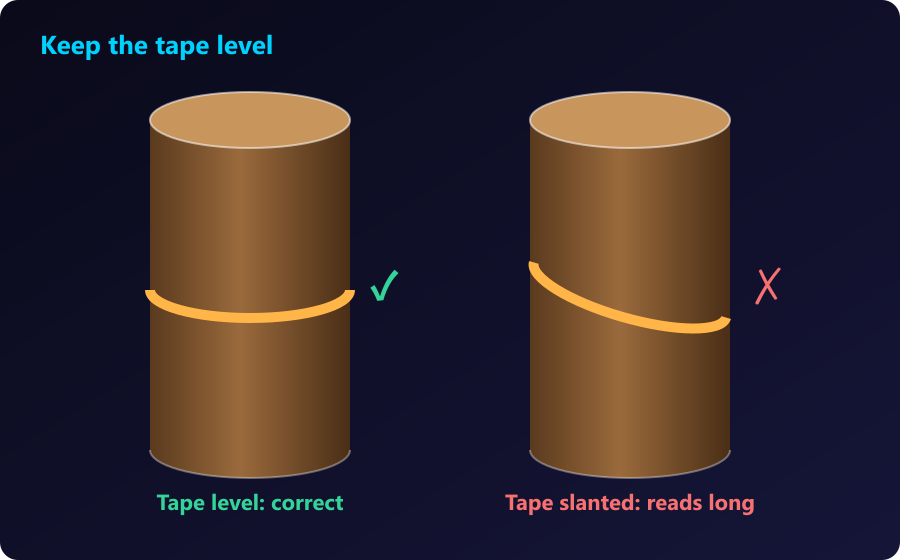
- Keep the tape level. A tape that slants around the object reads long. Hold it at the same height all the way round.
- Pull the tape snug. A slack tape adds length. Pull it flat against the surface without stretching it.
- Average several readings on uneven objects. Measure tree trunks, logs, and old pillars at 3 or more heights, then use the mean.
- Avoid bulges and knots. Move the tape above or below branch stubs, flanges, rims, and seams.
- Use the inside measurement for capacity. A drum’s outer circumference includes the wall. Subtract 2π × wall thickness from C, if you need the inside volume.
Small errors grow in the answer. C is squared in the formula, so a 2% error in the circumference gives about a 4% error in the volume.
Practice Questions with Answers
- A tin has a circumference of 31.4 cm and a height of 10 cm. Find its volume.
- A drum has a circumference of 1.79 m and a height of 0.88 m. Find its volume in litres.
- A round column has a circumference of 94.2 cm and a height of 2.5 m. Find its volume in m³.
- A log has an average girth of 2.4 m and a length of 4 m. Estimate its timber volume.
Answers
- V = 31.4² × 10 ÷ 4π = 9,859.6 ÷ 12.566 ≈ 784.6 cm³.
- V = 1.79² × 0.88 ÷ 4π = 2.8196 ÷ 12.566 ≈ 0.2244 m³ = 224.4 L.
- C = 0.942 m. V = 0.942² × 2.5 ÷ 4π = 2.2184 ÷ 12.566 ≈ 0.1765 m³ (176.5 L).
- V = 2.4² × 4 ÷ 4π = 23.04 ÷ 12.566 ≈ 1.83 m³.
Frequently Asked Questions
Can you find the volume of a cylinder with only the circumference?
No, you need the height as well. The circumference gives the base area (C² ÷ 4π), and the height turns that area into a volume.
What is the base area from the circumference?
The base area from the circumference is A = C² ÷ 4π. A circumference of 2 m gives a base area of 4 ÷ 12.566 ≈ 0.318 m².
Is girth the same as circumference?
Yes, girth is the circumference of a tree trunk, log, or body measured around its widest or a set point. Foresters use the word girth for tree circumference.
How do I convert circumference to diameter?
Divide the circumference by π: d = C ÷ π. Then use the diameter method, if you prefer working with d.
The cylinder volume formula guide explains why V = πr²h works.