Volume of a Hollow Cylinder, Pipe or Tube
The volume of a hollow cylinder is V = π(R² − r²)h. Use radii, diameters or wall thickness, with PVC pipe, washer and steel pipe weight examples.
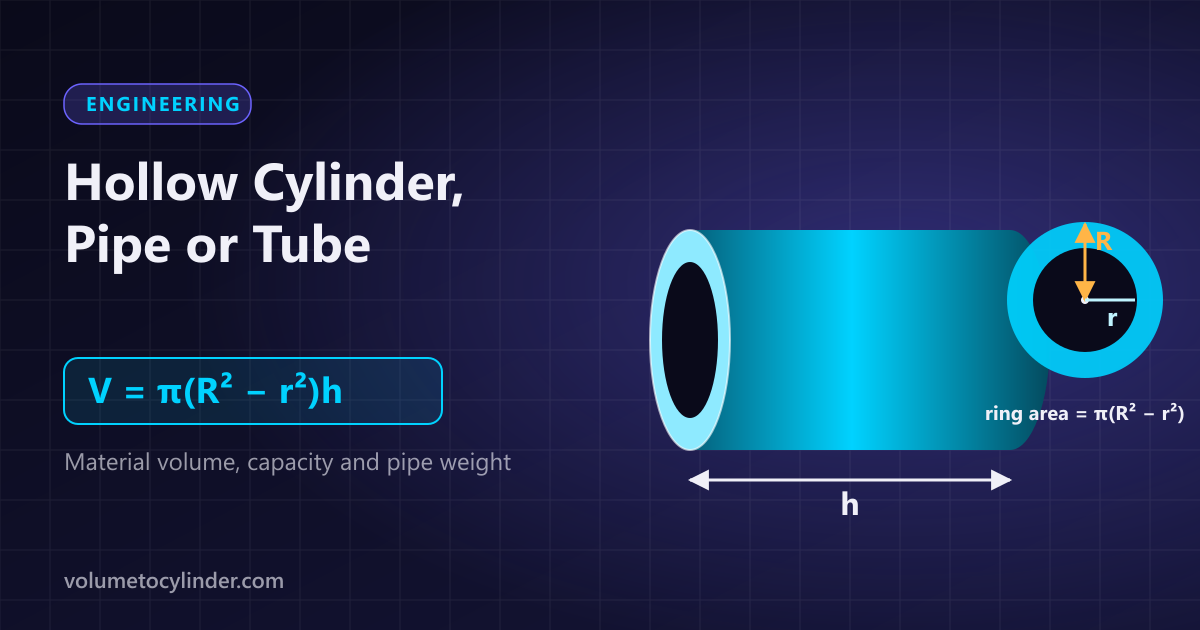
The volume of a hollow cylinder is V = π(R² − r²)h, where R is the outer radius, r is the inner radius, and h is the height or length. A hollow cylinder is a cylinder with a smaller, centred cylinder removed from its middle. Pipes, tubes, rings, sleeves, and bushings are all hollow cylinders.
The formula gives the volume of material in the wall, not the space inside. The hollow cylinder calculator runs this formula.
What Is the Formula for the Volume of a Hollow Cylinder?
The formula for the volume of a hollow cylinder is V = π(R² − r²)h.
The formula has 3 inputs:
- R (outer radius) is half the outside diameter (OD).
- r (inner radius) is half the inside diameter (ID), the radius of the hole.
- h (height) is the length of the pipe or the thickness of the ring.
R must be bigger than r. R² − r² is the area of the ring-shaped cross-section, which mathematicians call an annulus.
Why Does the Hollow Cylinder Formula Work?
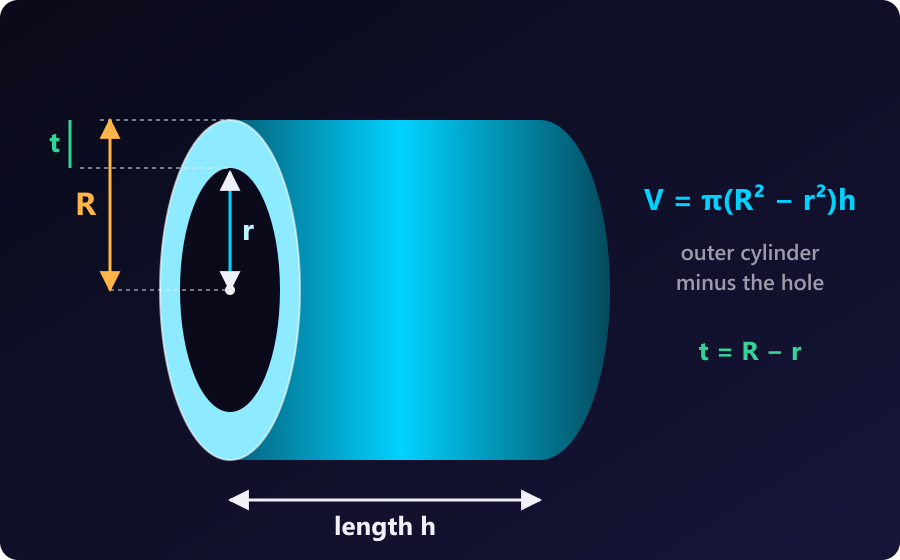
The hollow cylinder formula works since the volume of the wall equals the volume of the outer cylinder minus the volume of the inner “hole” cylinder.
- The outer cylinder has volume πR²h.
- The hole is a cylinder with volume πr²h.
- Subtracting gives πR²h − πr²h.
- Factoring out πh gives π(R² − r²)h.
Do not subtract the radii before squaring. π(R − r)²h is a different, smaller number, and it is wrong for a hollow cylinder.
How Do You Find Hollow Cylinder Volume Using Diameters?
To find hollow cylinder volume from diameters, use V = π(D² − d²)h ÷ 4, where D is the outside diameter and d is the inside diameter. Pipe catalogues list OD and ID, so this version saves 2 halving steps.
Example: a tube with D = 50 mm, d = 40 mm, and h = 1,000 mm.
- V = π × (50² − 40²) × 1,000 ÷ 4
- V = π × (2,500 − 1,600) × 1,000 ÷ 4
- V = π × 900 × 250 ≈ 706,858 mm³ ≈ 706.9 cm³
How Do You Find the Inner Radius from Wall Thickness?
To find the inner radius from wall thickness, subtract the wall thickness from the outer radius: r = R − t. Pipe specifications often give the outside diameter and the wall thickness (t) without the inside diameter.
In diameter terms, the inside diameter is d = D − 2t, since the wall appears on both sides of the hole.
Example: a pipe with an OD of 110 mm and a wall thickness of 5.3 mm.
- R = 110 ÷ 2 = 55 mm.
- r = 55 − 5.3 = 49.7 mm.
- d = 110 − 2 × 5.3 = 99.4 mm.
Example 1: Material Volume of a PVC Pipe
A polyvinyl chloride (PVC) pipe with an OD of 110 mm, a wall thickness of 5.3 mm, and a length of 6 m contains about 10,460 cm³ (10.46 L) of PVC.
- Convert the length to millimetres. h = 6 m = 6,000 mm.
- Find the radii. R = 55 mm, r = 55 − 5.3 = 49.7 mm.
- Square both radii. R² = 3,025 mm², r² = 2,470.09 mm².
- Subtract. R² − r² = 554.91 mm².
- Multiply by π. π × 554.91 ≈ 1,743.3 mm². This is the wall’s cross-sectional area.
- Multiply by the length. 1,743.3 × 6,000 ≈ 10,459,807 mm³.
- Convert to cm³. 10,459,807 ÷ 1,000 ≈ 10,459.8 cm³.
PVC has a density of about 1.4 g/cm³, so the pipe weighs 10,459.8 × 1.4 ≈ 14,644 g, or 14.6 kg (32.3 lb).
Example 2: Volume of a Metal Ring or Washer
A washer is a very short hollow cylinder, where h is the washer’s thickness. A steel washer with an OD of 30 mm, an ID of 13 mm, and a thickness of 2.5 mm has a volume of about 1,435 mm³ (1.44 cm³).
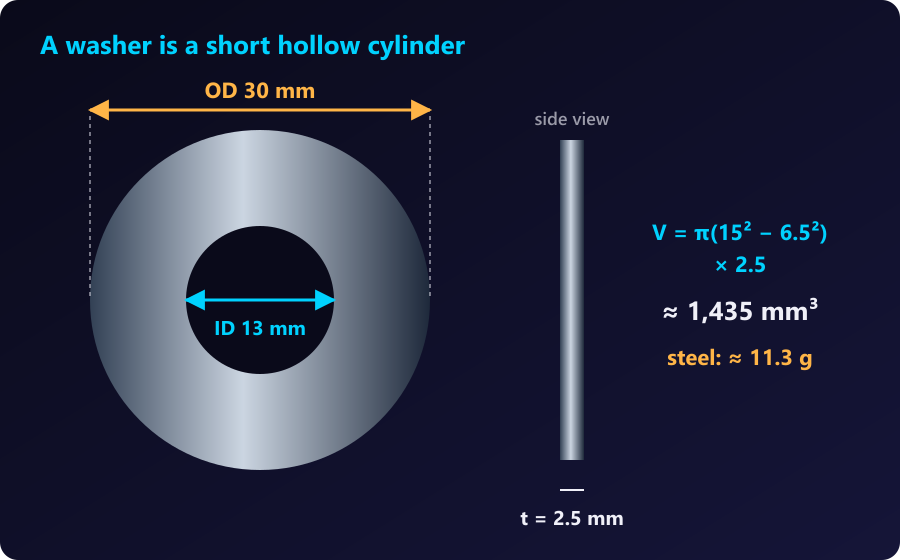
- Find the radii. R = 30 ÷ 2 = 15 mm, r = 13 ÷ 2 = 6.5 mm.
- Subtract the squares. 15² − 6.5² = 225 − 42.25 = 182.75 mm².
- Multiply by π. π × 182.75 ≈ 574.1 mm².
- Multiply by the thickness. 574.1 × 2.5 ≈ 1,435.3 mm³.
Steel has a density of 7.85 g/cm³, so the washer weighs 1.4353 × 7.85 ≈ 11.3 g. A box of 100 washers weighs about 1.13 kg.
What Is the Difference Between Material Volume and Capacity?
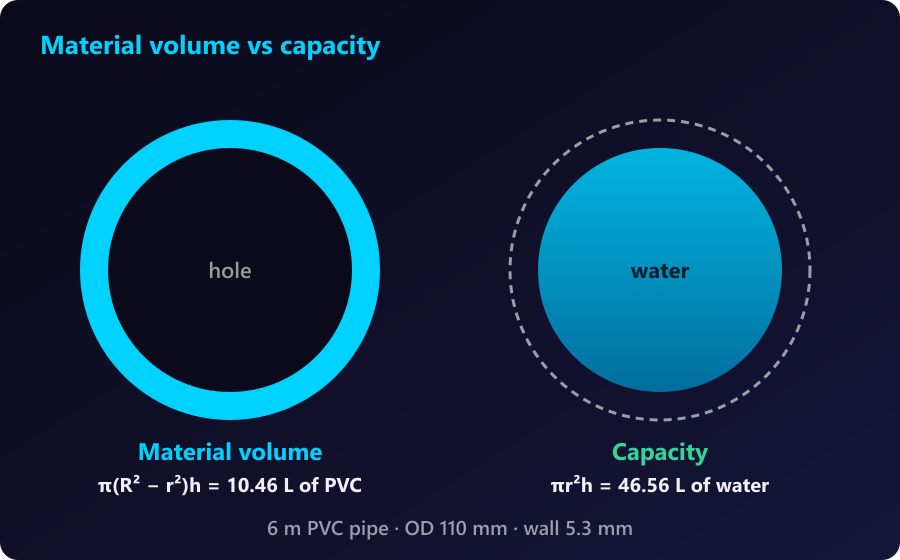
Material volume is the space taken by the pipe wall, and capacity is the space inside the pipe that holds liquid. The two numbers answer different questions:
| Measure | Formula | Answers the question | PVC pipe example (6 m) |
|---|---|---|---|
| Material volume | π(R² − r²)h | How much PVC or steel is in the pipe? | 10.46 L of PVC |
| Capacity (bore volume) | πr²h | How much water does the pipe hold? | 46.56 L of water |
| Total outer volume | πR²h | How much space does the pipe take up, hole included? | 57.02 L |
Material volume + capacity = total outer volume: 10.46 + 46.56 = 57.02 L. Use capacity to size a pipe for flow or to work out how much water drains from a line. Use material volume to find weight, cost, or recycling value.
How Do You Find the Weight of a Steel Pipe?
To find the weight of a steel pipe, multiply the material volume by the density of steel, 7.85 g/cm³ (7,850 kg/m³).
Example. A 2-inch Schedule 40 steel pipe has an OD of 60.3 mm and a wall thickness of 3.91 mm. Find the weight of a 6 m length.
- Radii: R = 60.3 ÷ 2 = 30.15 mm. r = 30.15 − 3.91 = 26.24 mm.
- Ring area: π × (30.15² − 26.24²) = π × (909.02 − 688.54) = π × 220.48 ≈ 692.7 mm².
- Material volume: 692.7 × 6,000 ≈ 4,156,000 mm³ = 4,156 cm³.
- Weight: 4,156 × 7.85 ≈ 32,620 g = 32.6 kg (71.9 lb).
This gives 5.44 kg per metre, which matches the published weight for 2-inch Schedule 40 pipe. The same 6 m pipe holds π × 26.24² × 6,000 ≈ 12.98 L of water when full. The volume to weight calculator covers other metals.
There are 4 common pipe material densities:
- Steel: 7.85 g/cm³.
- Copper: 8.96 g/cm³.
- Aluminium: 2.70 g/cm³.
- PVC: about 1.4 g/cm³.
Frequently Asked Questions
Is the volume of a pipe the water it holds?
No, the volume of a pipe usually means the volume of the pipe material, π(R² − r²)h. The water a pipe holds is its capacity, πr²h, which uses only the inner radius.
What is the formula for a hollow cylinder with diameters?
The formula is V = π(D² − d²)h ÷ 4, where D is the outside diameter and d is the inside diameter.
Can the inner radius be bigger than the outer radius?
No, the inner radius must be smaller than the outer radius. A negative answer means R and r are swapped.
What is the surface area of a hollow cylinder?
The total surface area of a hollow cylinder is 2πRh + 2πrh + 2π(R² − r²): the outer wall, the inner wall, and the two ring-shaped ends.
How do I find the volume of a cylinder without top and bottom?
A cylinder without top and bottom is an open tube. Its material volume uses the hollow cylinder formula. The without top and bottom calculator covers the surface area of that shape.