Cylinder Volume Conversions: Litres, Gallons, m³, ml and Cubic Yards
Convert cylinder volume between cm³, litres, ml, m³, US and UK gallons and cubic yards, with a full table, worked examples and volume to weight.
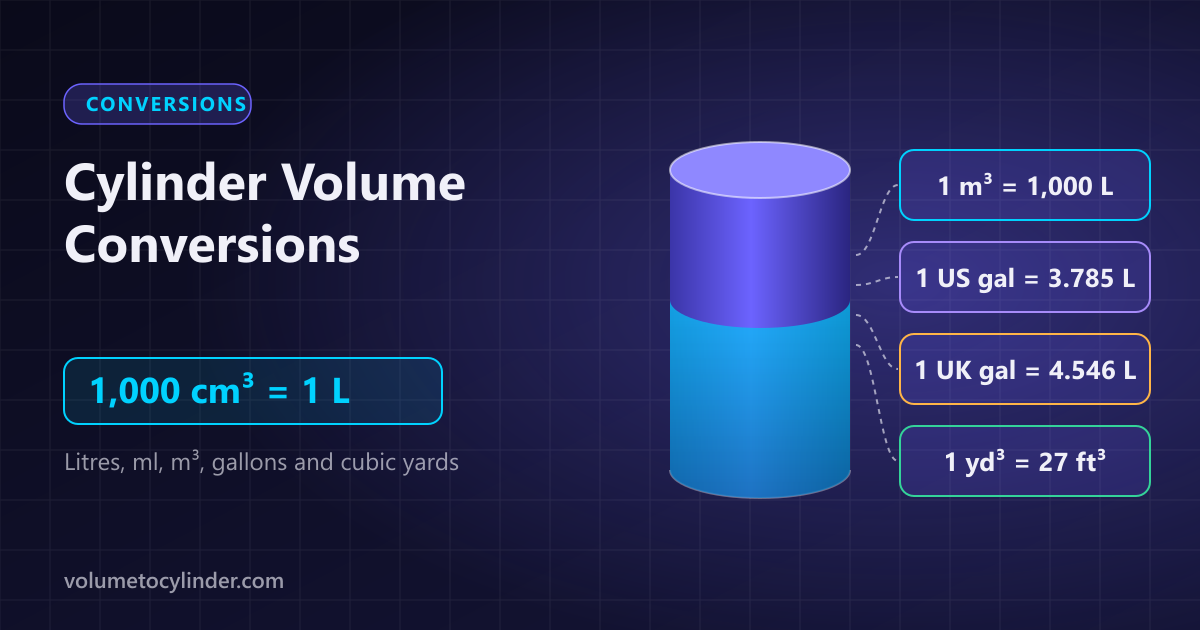
To convert a cylinder’s volume, divide cm³ by 1,000 to get litres, and divide litres by 3.785 to get US gallons. The formula V = πr²h gives volume in cubic units of whatever length you measured, such as cubic centimetres (cm³) or cubic metres (m³). Fuel, water, paint, and concrete are sold in litres (L), gallons (gal), or cubic yards (yd³), so the last step is a unit conversion.
This guide lists the conversion facts, gives a full conversion table, and works through 3 real examples. The litres calculator and gallons calculator do the conversion for you.
What Are the Key Cylinder Volume Conversion Facts?
There are 6 key conversion facts for cylinder volume:
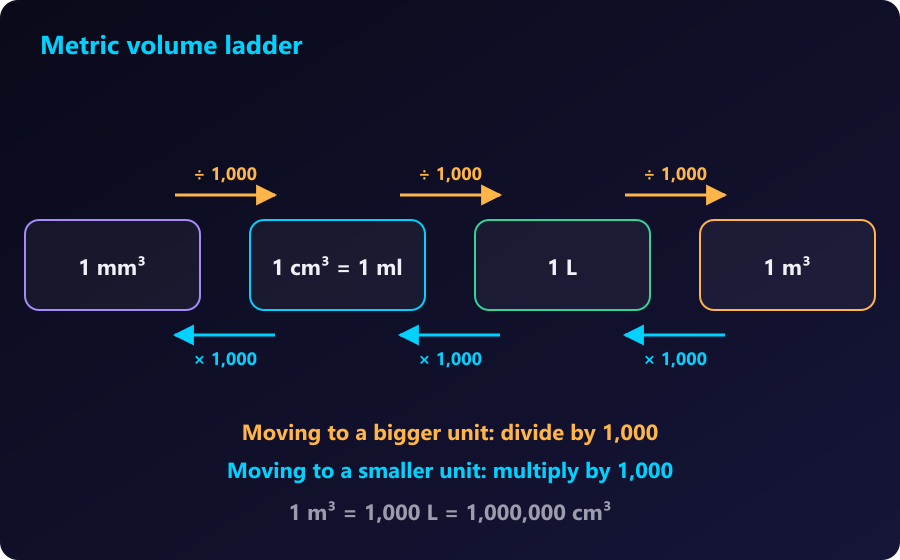
- 1,000 cm³ = 1 L. A litre is a cube 10 cm on each side.
- 1 cm³ = 1 millilitre (ml). The two units are identical.
- 1 m³ = 1,000 L. A cubic metre holds 1,000 litres.
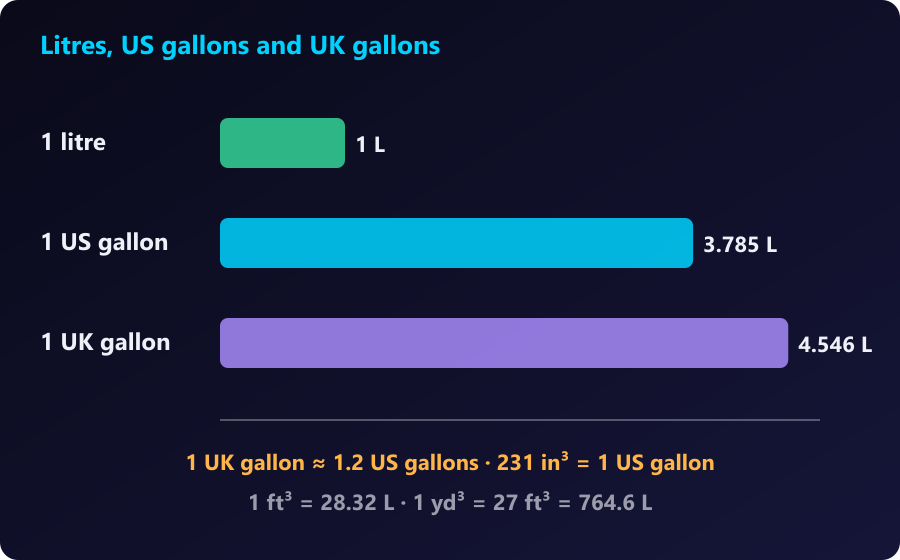
- 1 US gallon ≈ 3.785 L. One US gallon is exactly 231 cubic inches (in³).
- 1 imperial (UK) gallon ≈ 4.546 L. A UK gallon is about 20% bigger than a US gallon.
- 1 cubic yard = 27 cubic feet (ft³) ≈ 764.6 L. A cubic yard is a cube 3 ft on each side.
The National Institute of Standards and Technology (NIST) defines the US gallon as 231 in³ and the inch as 2.54 cm exactly.
Cylinder Volume Conversion Table
Read across a row to convert 1 unit of the left column into the other units.
| 1 unit of | Litres (L) | Cubic metres (m³) | Cubic feet (ft³) | US gallons | UK gallons | Cubic yards (yd³) |
|---|---|---|---|---|---|---|
| 1 cm³ (1 ml) | 0.001 | 0.000001 | 0.0000353 | 0.000264 | 0.00022 | 0.00000131 |
| 1 L | 1 | 0.001 | 0.03531 | 0.2642 | 0.2200 | 0.001308 |
| 1 in³ | 0.01639 | 0.0000164 | 0.000579 | 0.004329 | 0.003605 | 0.0000214 |
| 1 ft³ | 28.317 | 0.02832 | 1 | 7.4805 | 6.2288 | 0.03704 |
| 1 US gal | 3.7854 | 0.003785 | 0.13368 | 1 | 0.8327 | 0.004951 |
| 1 UK gal | 4.5461 | 0.004546 | 0.16054 | 1.2009 | 1 | 0.005946 |
| 1 m³ | 1,000 | 1 | 35.315 | 264.17 | 219.97 | 1.3080 |
| 1 yd³ | 764.55 | 0.76455 | 27 | 201.97 | 168.18 | 1 |
There are 4 shortcut rules from the table:
- cm³ → L: divide by 1,000.
- m³ → L: multiply by 1,000.
- in³ → US gal: divide by 231.
- ft³ → yd³: divide by 27.
Example in Litres: Volume of a Water Drum
A steel water drum with an inside diameter of 57 cm and a height of 85 cm holds about 216.9 L (57.3 US gallons).
- Find the radius. r = 57 ÷ 2 = 28.5 cm.
- Square the radius. 28.5² = 812.25 cm².
- Multiply by π and the height. V = π × 812.25 × 85 ≈ 216,899 cm³.
- Convert cm³ to litres. 216,899 ÷ 1,000 ≈ 216.9 L.
- Convert litres to US gallons. 216.9 ÷ 3.785 ≈ 57.3 US gal.
This drum matches the size of a standard “55-gallon” drum. The extra 2.3 gallons is headspace above the fill line.
Example in Gallons: A Tank Measured in Inches
A cylindrical tank with a diameter of 24 inches and a height of 48 inches holds about 94.0 US gallons (355.8 L).
- Find the radius. r = 24 ÷ 2 = 12 in.
- Calculate the volume in cubic inches. V = π × 12² × 48 = π × 6,912 ≈ 21,714.7 in³.
- Convert to US gallons. 21,714.7 ÷ 231 ≈ 94.0 US gal.
- Convert to UK gallons, if needed. 94.0 × 0.8327 ≈ 78.3 UK gal.
Convert feet to inches first (1 ft = 12 in), if the tank height is given in feet. Use 1 ft³ = 7.4805 US gallons, if you work in feet throughout. A 2 ft × 4 ft tank gives π × 1² × 4 ≈ 12.566 ft³, and 12.566 × 7.4805 ≈ 94.0 gallons, the same answer.
Example in Cubic Yards: A Concrete Column and a Round Planter
Ready-mix concrete and bulk soil are sold by the cubic yard, so cylinder volume in cubic feet needs one more division by 27.
Concrete Column
A round concrete column with a diameter of 18 in (1.5 ft) and a height of 10 ft needs about 0.65 cubic yards of concrete.
- Radius: 1.5 ÷ 2 = 0.75 ft.
- Volume: π × 0.75² × 10 ≈ 17.67 ft³.
- Cubic yards: 17.67 ÷ 27 ≈ 0.654 yd³.
- Metric check: 17.67 ft³ × 0.02832 ≈ 0.500 m³.
Concrete suppliers add 5–10% for waste and spillage, so order 0.7 yd³ for this column.
Round Planter
A round planter with a diameter of 3 ft and a depth of 2 ft holds about 0.52 cubic yards (14.1 ft³ or 400 L) of soil.
- Radius: 3 ÷ 2 = 1.5 ft.
- Volume: π × 1.5² × 2 ≈ 14.14 ft³.
- Cubic yards: 14.14 ÷ 27 ≈ 0.524 yd³.
- Bags: 14.14 ÷ 1.5 ft³ per bag ≈ 9.4, so buy 10 bags of 1.5 ft³ potting soil.
How Do You Convert Cylinder Volume to Weight?
To convert cylinder volume to weight, multiply the volume by the density of the material: mass = volume × density. The volume and density must share a unit, such as litres with kg/L or m³ with kg/m³.
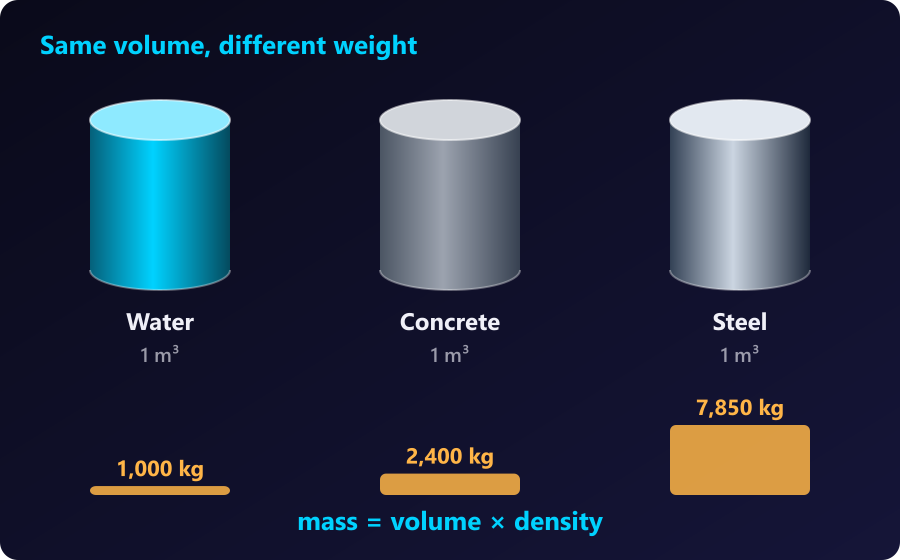
There are 3 common densities for cylinder problems:
| Material | Density (metric) | Density (US customary) |
|---|---|---|
| Water | 1 kg/L (1,000 kg/m³) | 8.34 lb per US gallon (62.4 lb/ft³) |
| Concrete | about 2,400 kg/m³ | about 150 lb/ft³ |
| Steel | about 7,850 kg/m³ (7.85 g/cm³) | about 490 lb/ft³ |
Water example. The 216.9 L water drum holds 216.9 × 1 kg/L ≈ 216.9 kg (478 lb) of water.
Concrete example. The 0.500 m³ concrete column weighs 0.500 × 2,400 ≈ 1,201 kg (about 2,650 lb).
Steel example. A solid steel bar with a diameter of 5 cm and a length of 1 m (100 cm) has a volume of π × 2.5² × 100 ≈ 1,963.5 cm³. Its mass is 1,963.5 × 7.85 ≈ 15,413 g, or 15.4 kg (34.0 lb).
The volume to weight calculator handles other materials.
Frequently Asked Questions
What is the difference between a US gallon and a UK gallon?
A US gallon equals 3.785 L (231 in³), and a UK (imperial) gallon equals 4.546 L. 1 UK gallon ≈ 1.2 US gallons. Use US gallons for American products and UK gallons for older British and Canadian measurements.
Is 1 ml the same as 1 cm³?
Yes, 1 millilitre (ml) is exactly the same volume as 1 cubic centimetre (cm³). Medical and lab equipment often labels volume in cc, which means cm³.
How many litres are in a cubic metre?
There are 1,000 litres in 1 cubic metre (m³). A tank with a volume of 2.5 m³ holds 2,500 L.
How do I convert cubic inches to gallons?
Divide cubic inches by 231 to get US gallons. Divide cubic inches by 277.42 to get UK gallons.
How many cubic feet are in a cubic yard?
There are 27 cubic feet in 1 cubic yard, since 3 ft × 3 ft × 3 ft = 27 ft³.