Volume of a Cylinder: Worked Examples and Practice Questions (with Answers)
19 cylinder volume practice questions at 4 levels, plus GCSE, Class 8/9 and Grade 7 exam questions with full worked solutions and a free PDF worksheet.
This page has 19 cylinder volume practice questions at 4 levels and 9 exam-style questions, each with a full worked solution. Work through Level 1 to Level 4 in order, since each level adds one new skill. A free PDF worksheet with an answer key is at the end.
Cylinder Volume Formula Recap
Volume: V = πr²h · Using diameter: V = πd²h ÷ 4 · Height: h = V ÷ (πr²) · Radius: r = √(V ÷ πh) · Units: 1,000 cm³ = 1 L, 1 m³ = 1,000 L, 231 in³ = 1 US gallon
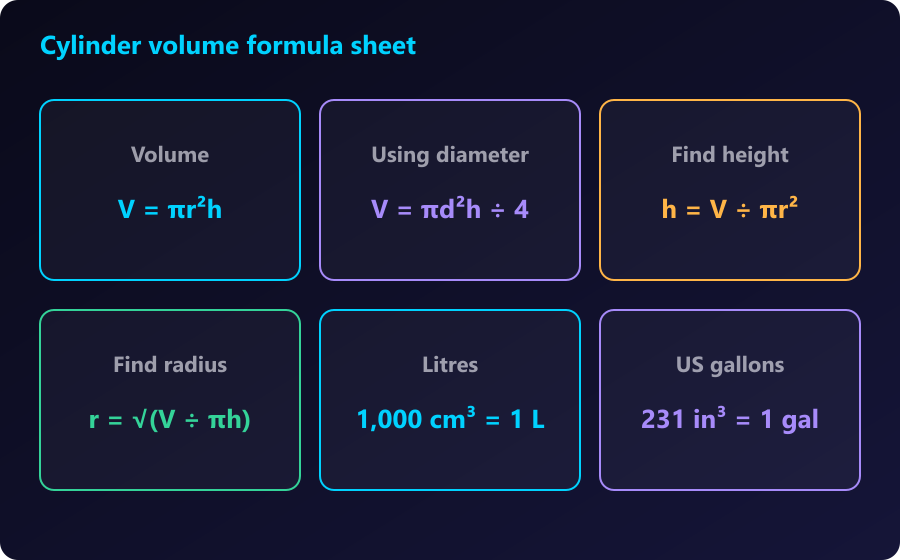
r is the radius, d is the diameter, and h is the height. Round answers to 2 decimal places, unless the question says otherwise. The cylinder volume formula guide explains each part.
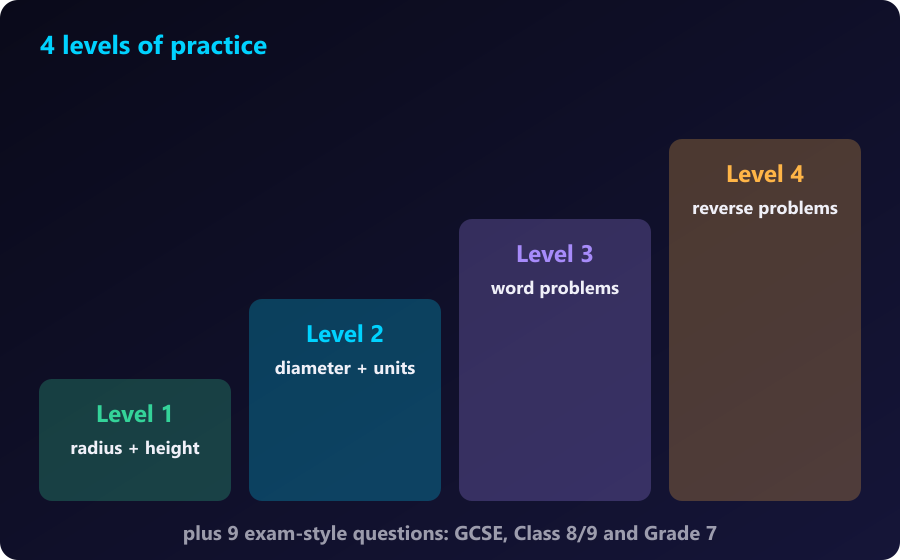
Level 1: Basic Questions with Radius and Height
Find the volume of each cylinder.
- r = 4 cm, h = 10 cm.
- r = 6 cm, h = 15 cm.
- r = 2.5 m, h = 8 m.
- r = 10 in, h = 3 in.
- r = 7 cm, h = 20 cm. Use π = 22/7.
Answers: 1) 502.65 cm³ 2) 1,696.46 cm³ 3) 157.08 m³ 4) 942.48 in³ 5) 3,080 cm³
Level 2: Questions with Diameter and Unit Conversion
- d = 12 cm, h = 25 cm. Find the volume.
- d = 1.4 m, h = 2 m. Find the volume in m³.
- r = 30 cm, h = 1.5 m. Find the volume in m³ and in litres.
- d = 8 in, h = 2 ft. Find the volume in cubic inches and in US gallons.
- d = 50 mm, h = 12 cm. Find the volume in millilitres (ml).
Answers: 6) 2,827.43 cm³ 7) 3.08 m³ 8) 0.424 m³ = 424.1 L 9) 1,206.37 in³ = 5.22 US gal 10) 235.62 ml
Level 3: Word Problems on Tanks, Pipes, Cans and Wells
- Water tank. A cylindrical water tank has a diameter of 1.5 m and a height of 2 m. How many litres does it hold?
- Well. A well with a diameter of 1.2 m is dug 14 m deep. How many cubic metres of earth are removed?
- Can. A can has a radius of 3.5 cm and a height of 12 cm. The factory fills it to 90%. How many millilitres of soup go into each can?
- Pipe. A water main has an inside diameter of 20 cm and a length of 50 m. How many litres of water fill the pipe?
- Rain barrel. A rain barrel has a diameter of 60 cm and a height of 90 cm. How many full 10-litre buckets can be filled from it?
Answers: 11) 3,534 L 12) 15.83 m³ 13) 415.6 ml 14) 1,571 L 15) 25 buckets
Level 4: Reverse Problems (Find the Height or Radius)
- V = 1,000 cm³, r = 5 cm. Find h.
- V = 500 cm³, h = 10 cm. Find r.
- V = 2 m³, d = 1 m. Find h.
- A 300-litre tank must be 1 m tall. Find the diameter.
Answers: 16) 12.73 cm 17) 3.99 cm 18) 2.55 m 19) 0.618 m (61.8 cm)
The height and radius guide teaches the rearranged formulas in full.
Exam-Style Questions
GCSE Style (UK)
General Certificate of Secondary Education (GCSE) questions ask for answers to 3 significant figures (s.f.) or in terms of π.
- G1. A cylinder has a radius of 4.5 cm and a height of 12 cm. Work out the volume of the cylinder. Give your answer correct to 3 significant figures. (2 marks)
- G2. A cylinder has a radius of 3 cm and a height of 8 cm. Work out the volume. Give your answer in terms of π. (2 marks)
- G3. A cylinder has a volume of 600 cm³ and a height of 15 cm. Work out the radius. Give your answer to 1 decimal place. (3 marks)
Answers: G1) 763 cm³ G2) 72π cm³ G3) 3.6 cm
Class 8 and Class 9 Style (CBSE, India)
Central Board of Secondary Education (CBSE) questions use π = 22/7.
- C1. A cylindrical tank has a radius of 1.4 m and a height of 3 m. How many litres of water can it hold?
- C2. The curved surface area of a cylinder is 88 cm² and its height is 14 cm. Find its volume.
- C3. A cylindrical pillar has a diameter of 50 cm and a height of 3.5 m. Find the volume of concrete in the pillar.
Answers: C1) 18,480 L C2) 44 cm³ C3) 0.6875 m³
Grade 7 Style (US)
US middle school questions often use π ≈ 3.14 and customary units.
- A1. A juice can has a radius of 2 in and a height of 5 in. Find its volume.
- A2. A round paddling pool has a diameter of 12 ft and a depth of 4 ft. Find its volume.
- A3. A cup has a diameter of 8 cm and a height of 10 cm. How many millilitres does it hold?
Answers: A1) 62.8 in³ A2) 452.16 ft³ A3) 502.4 ml
Full Worked Solutions
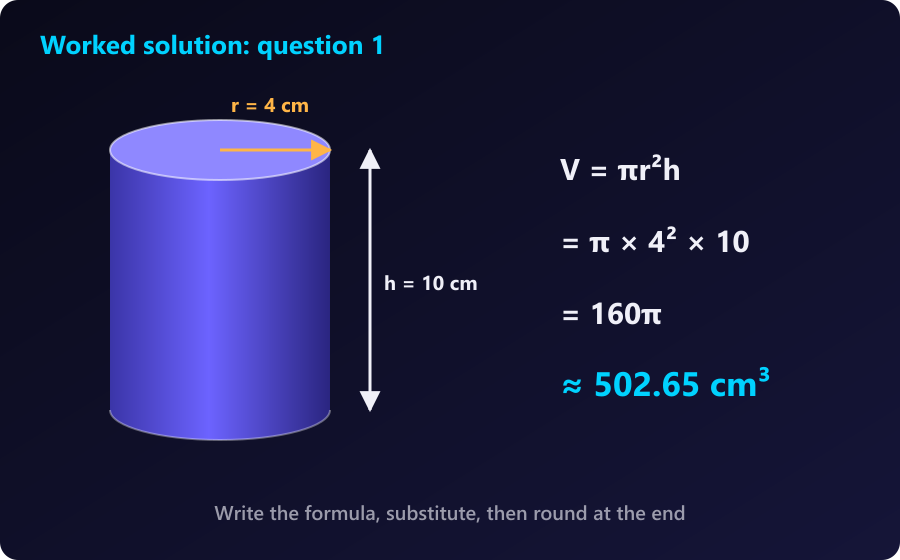
Level 1 Solutions
- V = π × 4² × 10 = π × 160 ≈ 502.65 cm³.
- V = π × 6² × 15 = π × 540 ≈ 1,696.46 cm³.
- V = π × 2.5² × 8 = π × 50 ≈ 157.08 m³.
- V = π × 10² × 3 = π × 300 ≈ 942.48 in³.
- V = 22/7 × 7² × 20 = 22/7 × 49 × 20 = 22 × 7 × 20 = 3,080 cm³.
Level 2 Solutions
- r = 12 ÷ 2 = 6 cm. V = π × 36 × 25 = 900π ≈ 2,827.43 cm³.
- r = 1.4 ÷ 2 = 0.7 m. V = π × 0.49 × 2 = 0.98π ≈ 3.08 m³.
- Convert r to metres: 30 cm = 0.3 m. V = π × 0.09 × 1.5 = 0.135π ≈ 0.424 m³. Litres: 0.424 × 1,000 ≈ 424.1 L.
- Convert h to inches: 2 ft = 24 in. r = 4 in. V = π × 16 × 24 = 384π ≈ 1,206.37 in³. Gallons: 1,206.37 ÷ 231 ≈ 5.22 US gal.
- Convert d to centimetres: 50 mm = 5 cm, so r = 2.5 cm. V = π × 6.25 × 12 = 75π ≈ 235.62 cm³ = 235.62 ml.
Level 3 Solutions
- r = 0.75 m. V = π × 0.5625 × 2 ≈ 3.534 m³. Litres: 3.534 × 1,000 ≈ 3,534 L.
- r = 0.6 m. V = π × 0.36 × 14 = 5.04π ≈ 15.83 m³ of earth.
- V = π × 3.5² × 12 = 147π ≈ 461.81 cm³. 90% of 461.81 ≈ 415.6 ml.
- r = 10 cm = 0.1 m. V = π × 0.01 × 50 = 0.5π ≈ 1.571 m³ = 1,571 L.
- r = 30 cm. V = π × 900 × 90 ≈ 254,469 cm³ = 254.5 L. Buckets: 254.5 ÷ 10 = 25.4, so 25 full buckets.
Level 4 Solutions
- h = V ÷ (πr²) = 1,000 ÷ (π × 25) = 1,000 ÷ 78.54 ≈ 12.73 cm.
- r = √(V ÷ πh) = √(500 ÷ (π × 10)) = √15.915 ≈ 3.99 cm.
- r = 0.5 m. h = 2 ÷ (π × 0.25) = 2 ÷ 0.7854 ≈ 2.55 m.
- V = 300 L = 0.3 m³. r = √(0.3 ÷ (π × 1)) = √0.09549 ≈ 0.309 m. d = 2 × 0.309 ≈ 0.618 m.
Exam Solutions
- G1. V = π × 4.5² × 12 = π × 243 ≈ 763.407 cm³ → 763 cm³ (3 s.f.).
- G2. V = π × 3² × 8 = 72π cm³.
- G3. 600 = π × r² × 15 → r² = 600 ÷ (15π) ≈ 12.732 → r ≈ 3.568 → 3.6 cm.
- C1. V = 22/7 × 1.4² × 3 = 22/7 × 1.96 × 3 = 18.48 m³. 18.48 × 1,000 = 18,480 L.
- C2. CSA = 2πrh → 88 = 2 × 22/7 × r × 14 → 88 = 88r → r = 1 cm. V = 22/7 × 1² × 14 = 44 cm³.
- C3. r = 25 cm = 0.25 m. V = 22/7 × 0.0625 × 3.5 = 0.6875 m³.
- A1. V = 3.14 × 2² × 5 = 3.14 × 20 = 62.8 in³.
- A2. r = 6 ft. V = 3.14 × 36 × 4 = 452.16 ft³.
- A3. r = 4 cm. V = 3.14 × 16 × 10 = 502.4 cm³ = 502.4 ml.
Free Downloadable Cylinder Volume Worksheet (PDF)
The cylinder volume worksheet PDF has all 19 practice questions and 9 exam questions on printable pages, with an answer key on the last page. Teachers can print it for class, homework, or revision.
Check any answer with the cylinder volume calculator. The using-diameter calculator and the without-height calculator cover Levels 2 and 4.