How to Calculate the Volume of a Cylindrical Tank (Vertical and Horizontal)
Calculate cylindrical tank volume for full and partly filled vertical and horizontal tanks, with a dipstick example and a fill chart in litres.
The volume of a cylindrical tank is V = πr²h, where r is the tank’s inside radius and h is its height (vertical tank) or length (horizontal tank). Cylindrical tanks store water, diesel, heating oil, and chemicals, since a round wall spreads pressure evenly and uses less steel than a box of the same capacity.
There are 4 tank cases, and each needs a slightly different calculation:
- Vertical tank, full.
- Vertical tank, partly filled.
- Horizontal tank, full.
- Horizontal tank, partly filled.
The tank volume calculator solves all 4 cases.
How Do You Calculate the Volume of a Full Vertical Tank?
To calculate the volume of a full vertical tank, multiply the base area by the tank height: V = πr²h. Measure the inside diameter and halve it to get r.
Example. A vertical water tank has an inside diameter of 2 m and a height of 2.5 m.
- Radius: r = 2 ÷ 2 = 1 m.
- Volume: V = π × 1² × 2.5 ≈ 7.854 m³.
- Litres: 7.854 × 1,000 = 7,854 L (about 2,075 US gallons).
How Do You Calculate the Volume of a Partly Filled Vertical Tank?
To calculate the liquid in a partly filled vertical tank, use the liquid height instead of the tank height: V = πr² × liquid height. The cross-section of a vertical tank is the same circle at every level, so the volume rises in a straight line with the liquid depth.
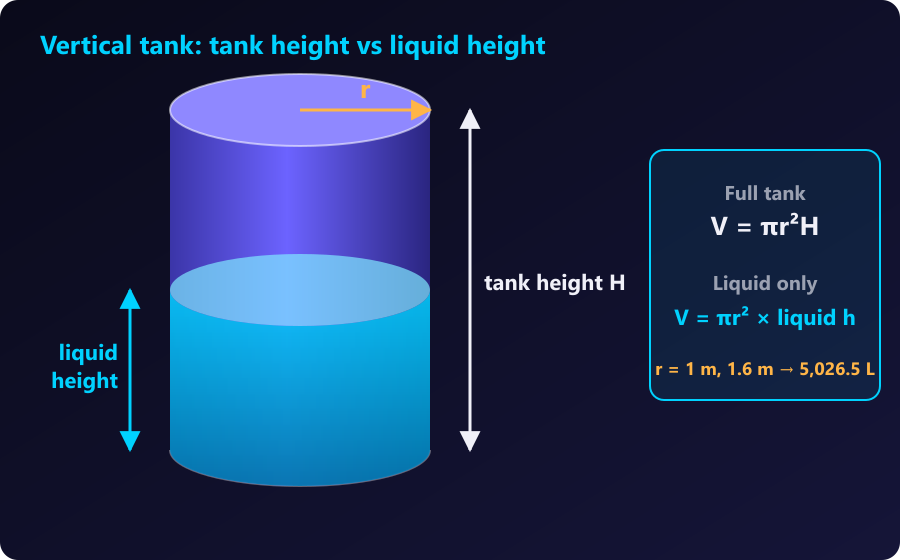
Example. The same 2 m wide tank holds water to a depth of 1.6 m.
- Volume: V = π × 1² × 1.6 ≈ 5.027 m³.
- Litres: 5,026.5 L.
- Fill percentage: 1.6 ÷ 2.5 = 64% full.
Each 1 cm of depth in this tank holds π × 100² × 1 ≈ 31,416 cm³, or 31.4 L. That number lets you mark a gauge on the tank wall. The vertical tank calculator runs this case.
How Do You Calculate the Volume of a Full Horizontal Tank?
To calculate the volume of a full horizontal tank, use the same formula, with the tank length taking the place of the height: V = πr²L. Turning a cylinder on its side does not change its volume.
Example. A horizontal tank has an inside diameter of 1.2 m and a length of 3 m.
- Radius: r = 1.2 ÷ 2 = 0.6 m.
- Volume: V = π × 0.6² × 3 ≈ 3.393 m³.
- Litres: 3,392.9 L (about 896 US gallons).
How Do You Calculate the Volume of a Partly Filled Horizontal Tank?
To calculate the liquid in a partly filled horizontal tank, multiply the area of the circular segment under the liquid by the tank length. The liquid’s cross-section is not a full circle, so V = πr² × depth gives the wrong answer here.
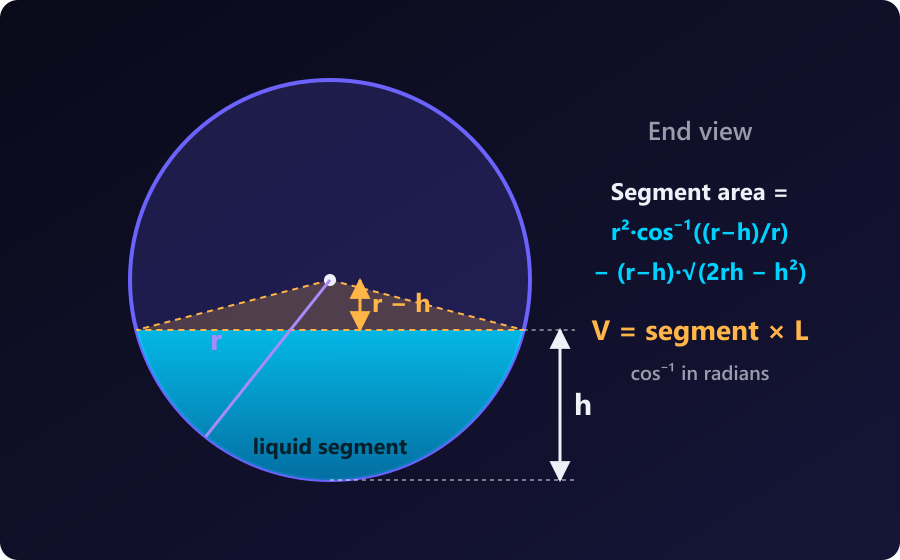
The horizontal tank formula is:
V = L × [r² · cos⁻¹((r − h) / r) − (r − h) · √(2rh − h²)]
The formula has 4 inputs:
- L is the inside length of the tank.
- r is the inside radius.
- h is the liquid depth, measured from the bottom of the tank.
- cos⁻¹ is the inverse cosine (arccos), and its answer must be in radians, not degrees.
The bracket has 2 terms:
- r² · cos⁻¹((r − h)/r) is the area of the pie-slice (sector) that reaches down to the liquid.
- (r − h) · √(2rh − h²) is the area of the triangle between the centre of the tank and the liquid surface.
Sector minus triangle leaves the segment of liquid. The formula works for any depth from 0 to 2r. For h above the centre line, (r − h) turns negative, and the second term adds area instead of removing it.
Worked Example: Horizontal Diesel Tank with a Dipstick Reading
A horizontal diesel tank with an inside diameter of 1.2 m and a length of 3 m shows a dipstick reading of 45 cm. The tank holds about 1,162 L (307 US gallons) of diesel.
Work slowly through 6 steps:
- Write the inputs in metres. r = 0.6 m, h = 0.45 m, L = 3 m.
- Find (r − h) / r. (0.6 − 0.45) ÷ 0.6 = 0.15 ÷ 0.6 = 0.25.
- Find the inverse cosine in radians. cos⁻¹(0.25) ≈ 1.3181 rad. Set the calculator to RAD mode first.
- Find the sector term. r² × 1.3181 = 0.36 × 1.3181 ≈ 0.47452 m².
- Find the triangle term. √(2 × 0.6 × 0.45 − 0.45²) = √(0.54 − 0.2025) = √0.3375 ≈ 0.58095. Multiply by (r − h): 0.15 × 0.58095 ≈ 0.08714 m².
- Subtract, then multiply by L. Segment area = 0.47452 − 0.08714 ≈ 0.38738 m². V = 0.38738 × 3 ≈ 1.1621 m³ = 1,162.1 L.
The full tank holds 3,392.9 L, so the tank is 1,162.1 ÷ 3,392.9 ≈ 34.3% full by volume. The dipstick shows 45 ÷ 120 = 37.5% of the diameter. Volume percentage and depth percentage differ in a horizontal tank, since the tank is narrow at the bottom and widest at the middle.
Horizontal Tank Fill Chart: Fill Percentage Against Volume
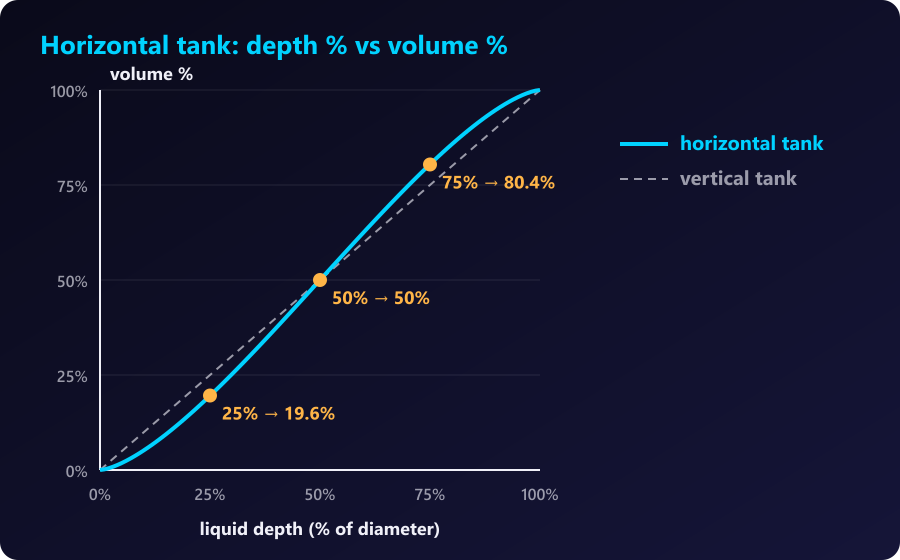
This fill chart gives volume percentage for each depth percentage in any horizontal cylindrical tank with flat ends. The litre and gallon columns apply to the 1.2 m × 3 m example tank.
| Liquid depth (% of diameter) | Dipstick reading (cm) | Volume (% of full) | Litres | US gallons |
|---|---|---|---|---|
| 5% | 6 | 1.9% | 63 | 17 |
| 10% | 12 | 5.2% | 177 | 47 |
| 20% | 24 | 14.2% | 483 | 128 |
| 25% | 30 | 19.6% | 663 | 175 |
| 30% | 36 | 25.2% | 856 | 226 |
| 40% | 48 | 37.4% | 1,267 | 335 |
| 50% | 60 | 50.0% | 1,696 | 448 |
| 60% | 72 | 62.6% | 2,126 | 562 |
| 70% | 84 | 74.8% | 2,537 | 670 |
| 75% | 90 | 80.4% | 2,730 | 721 |
| 80% | 96 | 85.8% | 2,910 | 769 |
| 90% | 108 | 94.8% | 3,216 | 850 |
| 95% | 114 | 98.1% | 3,329 | 880 |
| 100% | 120 | 100.0% | 3,393 | 896 |
To use the chart for another tank, find the volume percentage for your depth percentage and multiply it by your tank’s full volume. A tank with a full volume of 10,000 L at 25% depth holds 0.196 × 10,000 ≈ 1,960 L. Fuel suppliers call this kind of table a dip chart or strapping table. The horizontal tank calculator gives exact values for any depth.
What About Tanks with Rounded Ends?
Tanks with rounded ends need the volume of the ends added to the cylinder. A tank with 2 hemispherical ends holds V = πr²L + ⁴⁄₃πr³, where L is the length of the straight cylinder section. The cylinder, cone and sphere guide works through a capsule tank example. Many road tankers and propane tanks use shallower dished or elliptical heads, so check the manufacturer’s capacity plate for those.
How Do You Convert Tank Volume to Litres or Gallons?
To convert tank volume to litres, multiply cubic metres by 1,000, or divide cubic centimetres by 1,000. To convert litres to US gallons, divide by 3.785. A tank measured in inches converts to US gallons by dividing cubic inches by 231. The cylinder volume conversions guide lists every factor.
Frequently Asked Questions
Is a half-full horizontal tank holding half its volume?
Yes, a horizontal cylindrical tank filled to exactly half its diameter holds exactly 50% of its volume, since the liquid fills one half of the circle. At every other depth the percentages differ. A depth of 25% gives only 19.6% of the volume.
Should I use the inside or outside diameter of a tank?
Use the inside diameter to calculate how much liquid a tank holds. Subtract twice the wall thickness from the outside diameter, if you can only measure the outside.
Why does my calculator give the wrong answer for the horizontal tank formula?
The calculator is set to degrees. The inverse cosine in the horizontal tank formula must return radians. cos⁻¹(0.25) equals 1.3181 in radians and 75.52 in degrees.
How many litres does a 1,000-gallon tank hold?
A 1,000 US gallon tank holds about 3,785 L. A 1,000 UK gallon tank holds about 4,546 L.
How do I find the height a tank needs for a set capacity?
Divide the volume by the base area: h = V ÷ (πr²). The height and radius guide shows the full method.