Cylinder vs Cone vs Sphere: How Their Volumes Compare
A cone holds one-third of a matching cylinder and a sphere fills two-thirds. See the 1:2:3 ratio, hemispheres, capsules and worked examples.
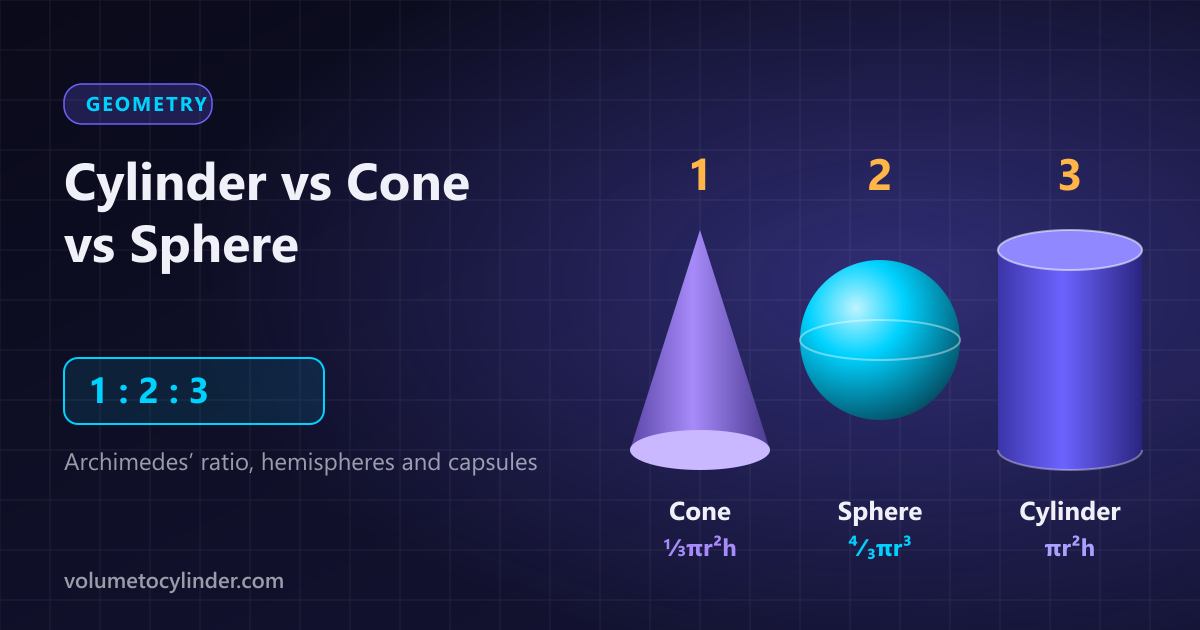
A cone holds one-third of the volume of a cylinder with the same base and height, and a sphere fills two-thirds of the cylinder that just encloses it. The Greek mathematician Archimedes of Syracuse proved the sphere–cylinder result around 225 BC in his book On the Sphere and Cylinder. Archimedes valued the result so much that he asked for a sphere inside a cylinder to be carved on his tomb. The Roman writer Cicero found the tomb in 75 BC by spotting that carving.
This guide sets out the 3 formulas, explains each ratio, and works through composite shapes such as capsules and silos. The cylinder vs cone calculator and the cylinder vs sphere calculator compare any sizes.
What Are the Volume Formulas for a Cylinder, Cone and Sphere?
The volume formulas are cylinder V = πr²h, cone V = ⅓πr²h, and sphere V = ⁴⁄₃πr³.
| Shape | Volume formula | Inputs | Fraction of matching cylinder |
|---|---|---|---|
| Cylinder | πr²h | radius r, height h | 1 (whole) |
| Cone | ⅓πr²h | radius r, height h | ⅓ |
| Sphere | ⁴⁄₃πr³ | radius r only | ⅔ (when h = 2r) |
| Hemisphere | ⅔πr³ | radius r only | ⅓ of a cylinder with h = 2r, ⅔ of a cylinder with h = r |
All 3 formulas share πr², the area of a circle. The cone and cylinder both use a height. The sphere uses only its radius, since its height is always its diameter, 2r.
How Does a Cylinder Compare with a Cone?
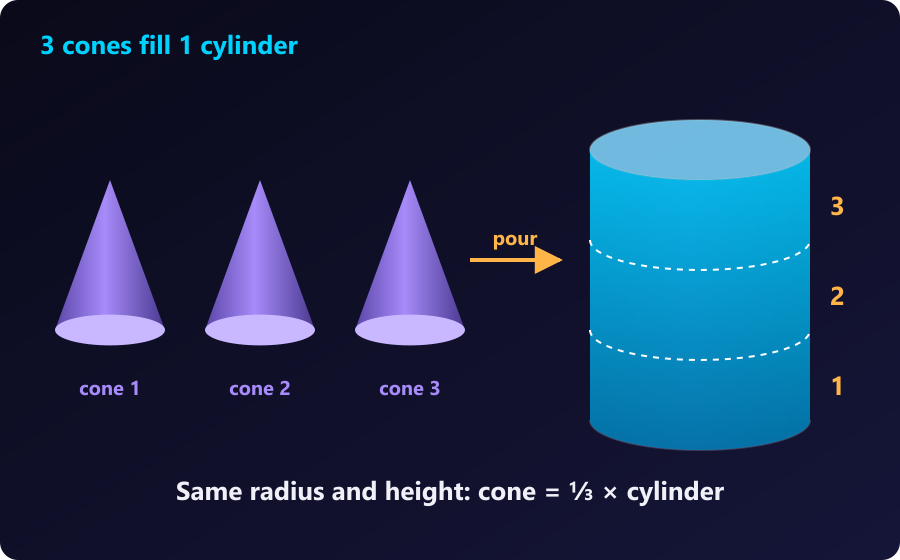
A cone holds exactly one-third of the volume of a cylinder with the same radius and height. Three full cones of water fill one cylinder.
The Pouring-Water Demonstration
The classroom test takes 4 steps:
- Take a hollow cone and a hollow cylinder with the same base radius and the same height.
- Fill the cone with water or rice.
- Pour the cone into the cylinder.
- Repeat. The cylinder fills on the third pour, every time.
The test works with any matching pair. A cone of r = 5 cm and h = 10 cm holds ⅓ × π × 25 × 10 ≈ 261.8 cm³. A cylinder of the same size holds π × 25 × 10 ≈ 785.4 cm³. 785.4 ÷ 261.8 = 3.
The one-third rule applies to all pyramids and cones. A square pyramid holds one-third of the cube-shaped prism with the same base and height.
How Does a Cylinder Compare with a Sphere?
A sphere fills exactly two-thirds of the cylinder that just encloses it. The enclosing cylinder has the same radius as the sphere and a height equal to the sphere’s diameter (h = 2r).
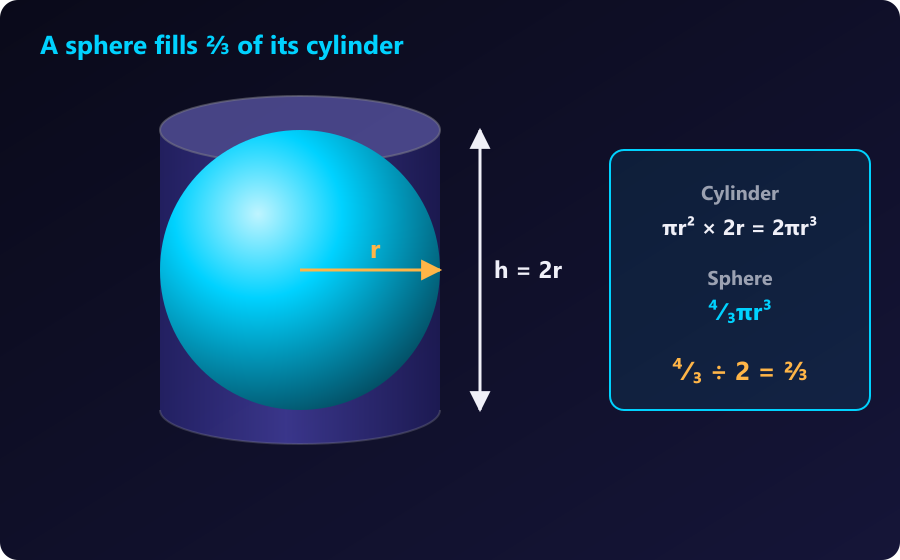
The proof takes 3 lines:
- Enclosing cylinder: V = πr² × 2r = 2πr³.
- Sphere: V = ⁴⁄₃πr³.
- Ratio: ⁴⁄₃πr³ ÷ 2πr³ = ⁴⁄₃ ÷ 2 = ⅔.
Archimedes found a second match: the sphere’s surface area (4πr²) is ⅔ of the enclosing cylinder’s total surface area (2πr² + 2πr × 2r = 6πr²). The ⅔ ratio holds for both volume and surface area.
A tennis ball tube shows the volume rule. A tube holding 1 ball of radius 3.3 cm has a volume of π × 3.3² × 6.6 ≈ 225.8 cm³, and the ball fills ⁴⁄₃ × π × 3.3³ ≈ 150.5 cm³, which is ⅔ of the tube.
What Is the Cone : Sphere : Cylinder Ratio?
The volumes of a cone, a sphere, and a cylinder are in the ratio 1 : 2 : 3, when all 3 shapes have the same radius r and the height equals the diameter (h = 2r).
With h = 2r:
- Cone: ⅓πr² × 2r = ⅔πr³ → 1 part.
- Sphere: ⁴⁄₃πr³ → 2 parts.
- Cylinder: πr² × 2r = 2πr³ → 3 parts.
Example with r = 5 cm and h = 10 cm:
| Shape | Volume | Ratio |
|---|---|---|
| Cone | 261.8 cm³ | 1 |
| Sphere | 523.6 cm³ | 2 |
| Cylinder | 785.4 cm³ | 3 |
So the cone plus the sphere equals the cylinder: 261.8 + 523.6 = 785.4 cm³.
What Is the Volume of a Hemisphere?
The volume of a hemisphere is V = ⅔πr³, half the volume of a sphere. A hemisphere with r = 3 cm has V = ⅔ × π × 27 ≈ 56.55 cm³.
A hemisphere of radius r equals ⅔ of a cylinder with radius r and height r. Domes, bowls, and the rounded ends of tanks are hemispheres.
How Do You Find the Volume of a Cylinder with Hemispherical Ends?
To find the volume of a cylinder with hemispherical ends, add the cylinder to one full sphere: V = πr²h + ⁴⁄₃πr³. Here h is the length of the straight middle section only. Two hemispherical ends join to make one sphere.
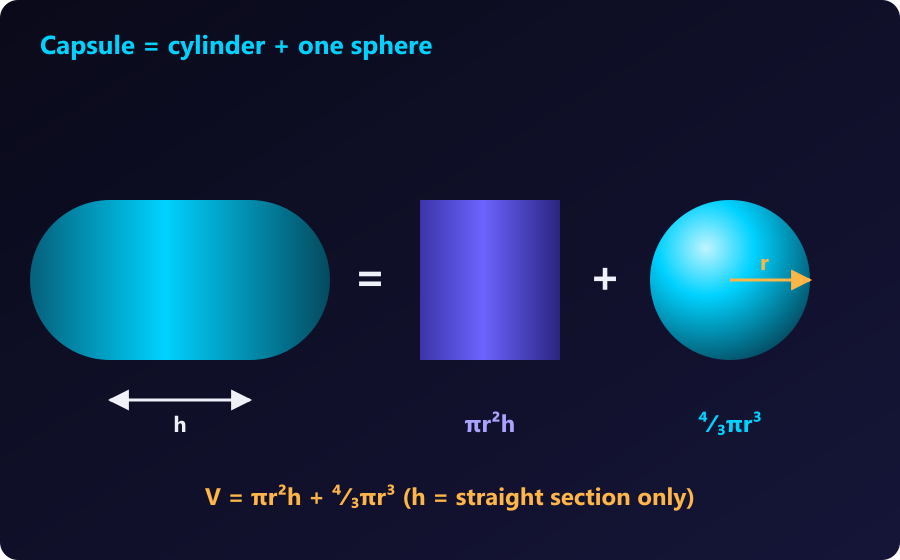
Capsule-shaped objects follow this rule, including:
- Medicine capsules and pills.
- Pressure tanks and some propane tanks.
- Submarine hulls and storage bullets.
Use V = πr²h + ⅔πr³, if the shape has only 1 hemispherical end, such as a silo with a dome roof.
Worked Examples: Ice-Cream Cone, Capsule and Silo
Example 1: An Ice-Cream Cone with a Scoop
A wafer cone has a radius of 3 cm and a height of 12 cm, topped with a hemisphere of ice cream with the same radius. The total volume of ice cream, when the cone is packed full, is about 169.6 cm³.
- Cone: ⅓ × π × 3² × 12 = 36π ≈ 113.10 cm³.
- Hemisphere: ⅔ × π × 3³ = 18π ≈ 56.55 cm³.
- Total: 113.10 + 56.55 ≈ 169.65 cm³.
Example 2: A Capsule Tank
A capsule tank has a radius of 1 m and a straight cylinder section 4 m long, with a hemisphere at each end. The tank holds about 16.76 m³ (16,755 L).
- Cylinder: π × 1² × 4 ≈ 12.566 m³.
- Two hemispheres (one sphere): ⁴⁄₃ × π × 1³ ≈ 4.189 m³.
- Total: 12.566 + 4.189 ≈ 16.755 m³.
The overall length of this tank is 4 + 2 × 1 = 6 m. A flat-ended tank 6 m long holds 18.85 m³, so the rounded ends cost about 2.1 m³ of capacity.
Example 3: A Grain Silo with a Dome Roof
A grain silo has a radius of 3 m, a cylindrical wall 15 m tall, and a hemispherical dome on top. The silo holds about 480.7 m³.
- Cylinder: π × 3² × 15 = 135π ≈ 424.12 m³.
- Hemisphere dome: ⅔ × π × 3³ = 18π ≈ 56.55 m³.
- Total: 424.12 + 56.55 ≈ 480.67 m³.
Wheat has a bulk density of about 0.78 tonnes per m³, so the full silo stores about 375 tonnes of wheat.
Practice Questions
- Find the volume of a cone with r = 4 cm and h = 9 cm.
- Find the volume of a sphere with r = 6 cm.
- Find the volume of a hemispherical bowl with r = 4.5 cm.
- A sphere of radius 2 cm sits inside a cylinder of radius 2 cm and height 4 cm. What fraction of the cylinder does the sphere fill?
- A capsule tank has r = 0.5 m and a cylinder section 2 m long. Find its volume.
Answers
- ⅓ × π × 16 × 9 = 48π ≈ 150.80 cm³.
- ⁴⁄₃ × π × 216 = 288π ≈ 904.78 cm³.
- ⅔ × π × 91.125 = 60.75π ≈ 190.85 cm³.
- Sphere ≈ 33.51 cm³, cylinder ≈ 50.27 cm³. The sphere fills ⅔ of the cylinder.
- π × 0.25 × 2 + ⁴⁄₃ × π × 0.125 ≈ 1.571 + 0.524 ≈ 2.094 m³ (2,094 L).
The cylinder volume formula guide explains where πr²h comes from.